


Certified Success: The Best Business Process Management Certifications in 2025
Is Your Business Running as Efficiently as It Could Be?
The best business process management certification for most professionals in 2025-2026 depends on your experience level and career goals. Here's a quick overview:
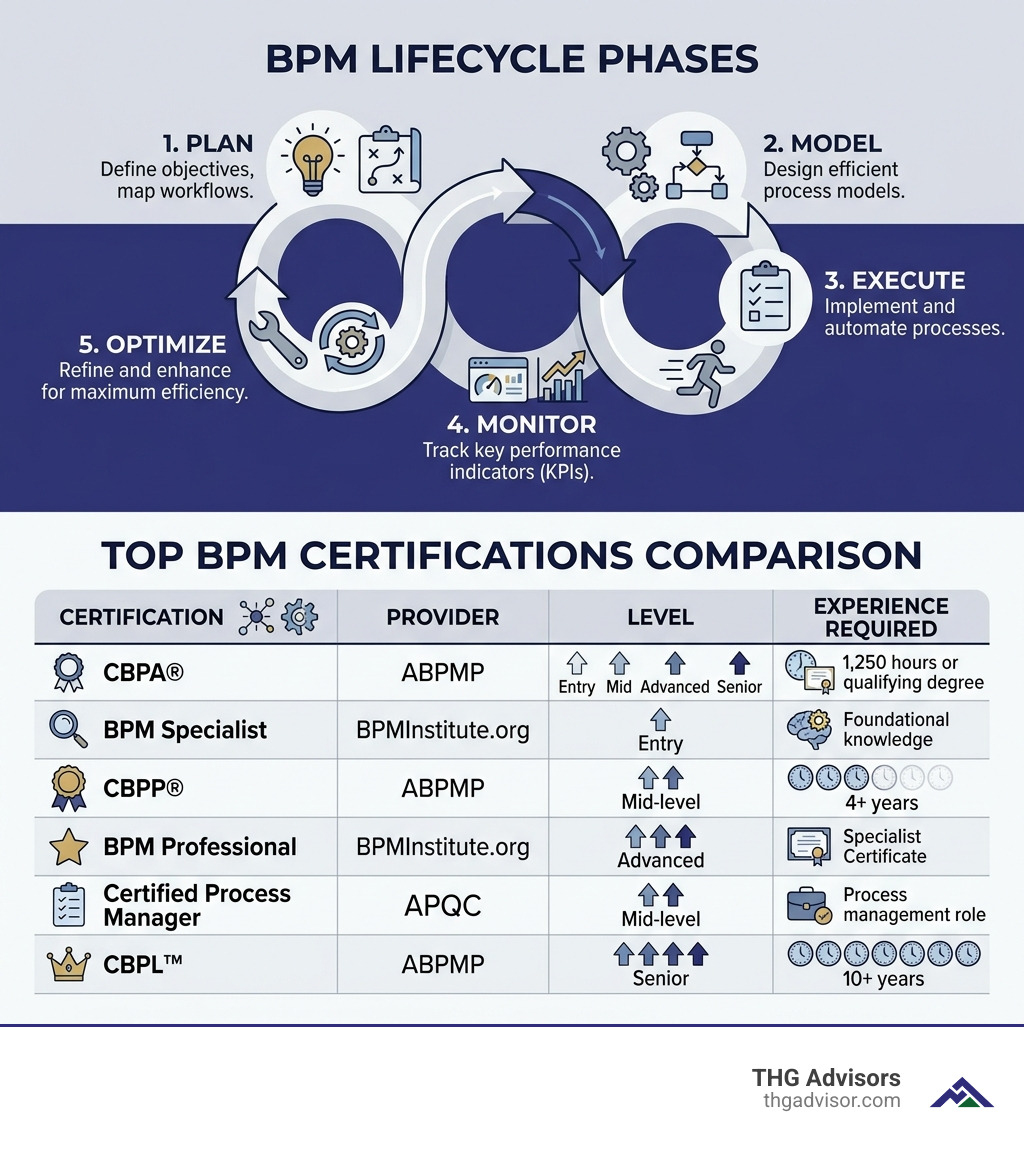
Certification Provider Level Experience Required CBPA® ABPMP Entry 1,250 hours or qualifying degree BPM Specialist BPMInstitute.org Entry Foundational knowledge CBPP® ABPMP Mid-level 4+ years BPM Professional BPMInstitute.org Advanced Specialist Certificate Certified Process Manager APQC Mid-level Process management role CBPL™ ABPMP Senior 10+ years
Business process management (BPM) is a discipline that helps organizations identify, improve, and optimize how work gets done — end to end. It's not just about fixing broken workflows. It's about building a competitive, agile operation that adapts fast and delivers results consistently.
For mid-sized business owners, that gap between how things are running and how they could run is often where growth stalls. The right BPM certification — whether for you or your team — closes that gap with proven frameworks and measurable outcomes.
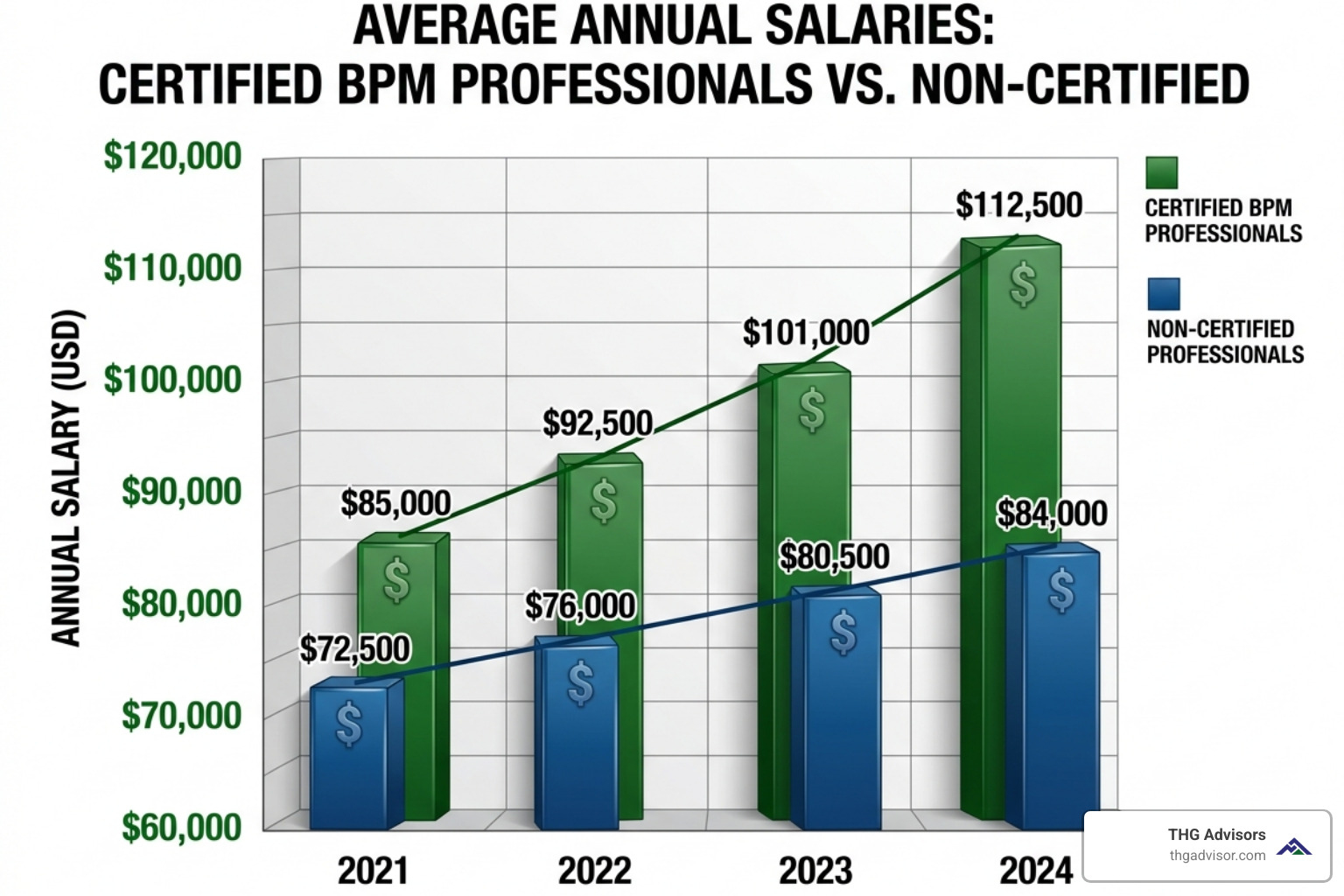
Certified professionals earn roughly 20% more than their non-certified peers, with salaries climbing into the low six figures. And 32% of newly certified professionals received a raise, with nearly a third of those earning raises above 20%. That's not just a career win — it's a signal that organizations value this expertise.
I'm Walt Carter, President & COO at THG Advisors, with over 30 years of experience leading digital transformation and operational excellence initiatives for major organizations. My hands-on work driving large-scale process improvements gives me a clear perspective on which best business process management certifications actually move the needle for business leaders. Let's break down the top options so you can choose the right path.
Why Pursue the Best Business Process Management Certification?
In the business environment of Atlanta and beyond, staying stagnant is the same as falling behind. Pursuing a BPM certification isn't just about adding letters after your name; it’s about mastering a methodology that identifies, evaluates, and improves business processes to reduce costs and errors.
The financial incentive is hard to ignore. Statistics show that BPM-certified professionals earn approximately 20% more than those without credentials. While a non-certified professional might see a salary in the high $90,000 range, those who have invested in the best business process management certification often cross into the low six figures. According to research, 32% of newly certified professionals received a raise shortly after passing their exams, with 31% of those seeing an increase of more than 20%.
Beyond the paycheck, these certifications provide much-needed credibility and marketability. In an era where Automation Process Improvement is a top priority for C-suite leaders, being able to prove you understand the BPM Certifications | Object Management Group standards sets you apart. It validates that you can lead process transformation, manage change, and align technical tools with strategic business goals.
Top BPM Certifications for 2025-2026: A Comprehensive Roundup
Choosing the right path requires looking at the heavy hitters in the industry. Organizations like the Association of Business Process Management Professionals (ABPMP), BPMInstitute.org, and APQC offer distinct pathways depending on your current role and where you want to go.
Entry-Level Best Business Process Management Certification Options
If you are just starting your journey or have a few years of experience, entry-level certifications focus on foundational modeling and the "language" of BPM, such as BPMN (Business Process Model and Notation).
Certified Business Process Associate (CBPA®): Offered by ABPMP, this is the gold standard for beginners. It requires 1,250 hours of documented work experience in a process-related area or a four-year qualifying university degree. It proves you understand the fundamental concepts of the BPM Common Body of Knowledge (CBOK).
BPM Specialist Certificate: Provided by BPMInstitute.org, this program focuses on the core skills needed to participate in process improvement teams. It’s an excellent way to gain foundational knowledge before moving toward the Business Process Management Professional Certificate | BPMInstitute.org.
University-Based Certificates: Schools like Villanova University offer a Business Process Management Certificate that lasts 24 weeks and covers three core courses. This is ideal for those who prefer an academic environment and want to earn a digital badge from a recognized institution.
Advanced Best Business Process Management Certification Programs
For those who have been "in the trenches" of process design and management for years, advanced certifications focus on leadership, governance, and enterprise-wide transformation.
Certified Business Process Professional (CBPP®): This is the mid-to-senior level benchmark. To qualify, you need at least 4 years of process management, improvement, or transformation experience. The Certified Business Process Professional (CBPP®) - PDCA Group training often helps professionals master the nine knowledge areas of the CBOK required to pass the 140-question exam.
Certified Process Manager: Offered by APQC, this 3-day immersive course focuses on their proprietary "Seven Tenets of Process Management." It's highly practical and designed for those who need to create board-ready process strategies. You can learn more at the Certified Process Manager | APQC page.
Certified Business Process Leader (CBPL™): The pinnacle of the ABPMP path, requiring 10 years of experience with a significant focus on process transformation and strategic leadership.
Comparing BPM to Six Sigma, ITIL, and Project Management
A common question we hear at THG Advisors is: "How does BPM differ from Six Sigma or PMP?" While they share a goal of improvement, their focus varies significantly.
BPM vs. Six Sigma: Six Sigma focuses on reducing defects and variability in a specific process. BPM is broader, looking at the end-to-end orchestration of multiple processes across the entire organization. Many professionals choose to combine them, seeking a Lean Six Sigma Certification - Scheller College of Business at Georgia Tech to complement their BPM knowledge.
BPM vs. ITIL: ITIL 4 is specifically geared toward IT service management. While BPM can be applied to IT, it is generally industry-agnostic and applies to HR, Finance, and Operations just as much as tech.
BPM vs. Project Management (PMP/PMI-ACP): Project management deals with unique, one-time endeavors with a specific start and end. BPM deals with repeatable, ongoing processes that form the heartbeat of the company.
For those in the Atlanta area, local institutions like Georgia State’s Robinson College of Business offer various Certificate Programs that help bridge these gaps, ensuring you have a well-rounded toolkit for operational excellence.
How to Choose the Right Certification Level
The ABPMP Competency Model is the best tool for deciding your path. It maps your years of experience and baseline skills to the appropriate certification.
If you are a manager in a growing company (perhaps between $10M and $250M in revenue), you might not need to be a CBPL, but having a team member with a best business process management certification like the CBPP can be a game-changer. These professionals know how to align processes with business strategy, ensuring that technology investments actually deliver ROI rather than just adding complexity.
Training formats have become incredibly flexible. You can choose from:
On-Demand: Self-paced video modules (ideal for busy executives).
Live Virtual: Real-time interaction with instructors.
In-Person: Intensive boot camps, like those offered by APQC or through Certified Business Process Professional (CBPP®) - PDCA Group.
Frequently Asked Questions about BPM Credentials
What is the average cost of a BPM certification?
The cost varies widely based on the provider and the depth of training.
Exam Fees: Usually range from $500 to $650 (ABPMP members often get a $150 discount).
Training Packages: Full certificate programs from the BPM Institute or Villanova can range from $3,995 to nearly $7,000 depending on whether you choose on-demand or face-to-face instruction.
Registration: Most associations charge a small application or registration fee (around $75).
How long does it take to get certified in BPM?
It depends on the intensity. Some "boot camp" styles take only 3 to 8 days of intensive training. University programs, like Villanova’s, typically run for 24 weeks. Most professionals find that 48 to 50 hours of dedicated training, plus additional study time for the exam, is the standard requirement.
What are the recertification requirements?
BPM is a living discipline. Most credentials, including the Business Process Manager (BPM) ® Certificate, require recertification every three years. This usually involves earning Continuing Education Credits (CECs) or Continuing Education Units (CEUs) through professional development, attending webinars, or contributing to the industry body of knowledge.
Conclusion: Driving Strategic Success in 2025-2026
In our work at THG Advisors, we see how process excellence separates the leaders from the laggards. Whether you are looking to boost your personal career or seeking to upskill your leadership team, investing in the best business process management certification is a strategic move.
Technology is a powerful lever, but it only works if the underlying processes are sound. That’s why our "Strategic CIO Catalyst Program" focuses so heavily on aligning IT strategy with operational reality. We turn IT from a cost center into a growth engine by ensuring your processes are optimized before the first line of code is written or the next software license is bought.
If you’re ready to stop "keeping the lights on" and start driving measurable growth through process and technology leadership, we’re here to help. Explore how we can support your journey through transformation readiness and operating model design. Let’s turn your operational complexity into your greatest competitive advantage.