

8 Real-World Examples of Automation Process Improvement That Scale
Why Automation Process Improvement Is the Competitive Edge Mid-Sized Businesses Can't Ignore
Automation process improvement is the practice of first optimizing how your business works — then using technology to run those better processes faster, cheaper, and with fewer errors.
Here's a quick breakdown of what it means and why it matters:
What It Is What It Does Who It's For Combining process optimization with automation tools Eliminates waste, reduces errors, cuts costs Any business with repetitive, rule-based workflows A strategic discipline, not just a tech project Frees your team for higher-value work Mid-sized businesses looking to scale Built on methodologies like Lean and Six Sigma Delivers measurable ROI within 6-12 months Organizations tired of manual bottlenecks
Most businesses don't have an automation problem. They have a process problem.
When companies automate a broken workflow, they don't fix it — they just break it faster. One HR professional watched an automation project spiral into chaos after her team skipped the process improvement step. The result? Duplicative workflows, new waste, and a frustrated team.
The good news: when done right, the results are dramatic. Insurance companies have cut claims processing time by 82%. Customer service teams have seen 93% faster response times. Manufacturers have saved hundreds of hours every month.
According to research from Gartner, 80% of business executives believe automation can be applied to any business decision — but knowing which processes to automate, and how to prepare them, is what separates organizations that scale from those that stall.
This guide walks through eight real-world examples of automation process improvement in action — so you can see exactly what's possible and where to start.
I'm Walt Carter, President & COO of THG Advisors, and over more than 30 years leading digital transformation at organizations like Fidelity, Gannett, and TRW, I've seen how a disciplined approach to automation process improvement separates companies that thrive from those that simply survive. The examples and frameworks ahead draw directly from that experience — and from the patterns I see repeatedly when advising mid-sized businesses today.
The Foundation: Why Process Improvement Must Precede Automation
We have a saying in the consulting world: "Automating a mess creates an automated mess." Before we ever touch a line of code or sign a software contract, we must look at the underlying workflow. Automation process improvement is not about the tool; it is about the strategy.

True improvement starts with root cause analysis. We often use the Lean Six Sigma DMAIC cycle (Define, Measure, Analyze, Improve, Control) to ensure we aren't just putting a digital Band-Aid on a gushing wound. By analyzing the "Improve" phase through the lens of technology, we can ensure that the solution actually solves the problem rather than just hiding it behind a dashboard.
To get started without starting from scratch, don’t reinvent the wheel with APQC’s PCF. This framework provides a standardized inventory of business processes that you can customize. Before you automate, you must ensure your organization is actually ready for the shift. You can find more info about transformation readiness services to help gauge your current state.
Avoiding the "Automated Chaos" Trap
If your current process involves three different spreadsheets, two verbal approvals, and a "gut feeling," automating it will result in total chaos. Standardization is the antidote. We must map the process, eliminate redundancies, and document the workflow until it is a predictable, repeatable sequence. Only then is it ready for a machine to handle.
The 3 Phases of Strategic Optimization
We typically guide our clients through three distinct phases:
Documenting Current State: Identifying exactly how work happens today (the "warts and all" version).
Evaluating Technology: Determining if your current tech stack can handle the load or if you need new tools.
Building an Automation Roadmap: Creating a prioritized list of what to automate first based on value and ease of implementation.
8 Real-World Examples of Automation Process Improvement
When we look at successful automation process improvement, we look for scalability and operational excellence. The goal is simple: reduce errors, save costs, and let your people do what they do best.
1. Streamlining Financial Operations with Automation Process Improvement
Finance is often the best place to start. Manual invoice processing is a notorious time-sink. In one real-world case, an insurance claims department used automation to validate data across multiple systems simultaneously. The result was a staggering 84% reduction in labor costs and a 79% decrease in error rates. By automating purchase orders and invoice matching, businesses move from reactive accounting to proactive financial strategy. For those looking to upgrade their tech stack, more info about technology enablement can provide the necessary roadmap.
2. Enhancing Customer Experience through Intelligent Workflows
We've all been stuck in "customer support limbo." By improving the process of support ticketing, companies can implement 24/7 self-service portals and automated SLA notifications. One organization reported 93% faster response times simply by using process orchestration to route tickets to the right person (or bot) instantly. This isn't just about speed; it's about consistency.
3. Optimizing Human Resources and Employee Onboarding
HR leaders often cite standardizing and optimizing processes as their top priority. Automation can handle recruitment screening, standardized documentation, and compliance audits with ease. This doesn't just save time; it improves talent retention by giving new hires a smooth, professional first week instead of a mountain of confusing paperwork.
4. Scaling Supply Chain and Inventory Management
In the supply chain, "real-time" is the only time that matters. By automating stock tracking and order fulfillment, companies have seen a 30-50% reduction in cycle times. Intelligent systems can even assist with demand forecasting, ensuring you aren't overstocked on items that aren't moving while your bestsellers sit on backorder.
5. Compliance and Audit Trail Transparency
For businesses in Atlanta and across Georgia, regulatory compliance is a heavy lift. Automation process improvement creates a digital "paper trail" that is impossible to replicate manually. This deter fraud and makes regulatory reporting a matter of clicking a button rather than weeks of forensic accounting.
6. Data Access and Security Request Handling
Security shouldn't be a bottleneck. By replacing manual emails with digital e-forms and automated approval routing, companies can handle identity management and secure permissions in minutes. This ensures that the right people have the right access without compromising the organization's safety.
7. Sales Conversion and Lead Management
Sales teams should be selling, not doing data entry. Integrating your CRM with automated lead management can lead to a 4% increase in sales conversions. By automating follow-ups and territory management, your reps can focus on building relationships while the system handles the "boring" parts of the funnel.
8. Internal Idea Generation and Innovation
Innovation shouldn't happen by accident. Using intranet forms and automated feedback loops ensures that great ideas from your frontline employees actually reach leadership. This improves employee engagement and aligns the team's creative energy with your strategic goals.
Key Technologies Driving Automation Process Improvement
The tools we use have evolved significantly. We no longer just use "bots"; we use intelligent systems that can reason and adapt.
Technology Best For Typical Impact RPA (Robotic Process Automation) Repetitive, rule-based tasks (data entry, screen scraping) 70-80% reduction in manual effort BPA (Business Process Management) End-to-end workflow orchestration across departments Improved visibility and compliance AI Agents Handling unstructured data (emails, PDFs) and complex decisions Adaptive, self-healing processes
It is no wonder that 80% of business executives believe automation applies to any business decision .
The Rise of AI Agents and Hyperautomation
We are entering the era of the "agentic enterprise." Traditional automation follows "if-then" logic, but AI agents use Large Language Models (LLMs) to handle unstructured data. They don't just follow a script; they can predict bottlenecks and prescribe the best course of action. This is the heart of hyperautomation—the orchestration of multiple technologies to automate as much as possible.
Low-Code Platforms and API Integration
You don't need a PhD in computer science to improve your processes anymore. Low-code platforms allow "citizen developers" within your business to build their own automations. This, combined with robust API integration, ensures that your Salesforce, NetSuite, and legacy systems all talk to each other seamlessly. For more on how to organize this data, see more info about AI for data management.
A Step-by-Step Framework for Successful Implementation
We don't recommend a "Big Bang" approach. Success comes from a phased rollout that builds momentum and proves value early.
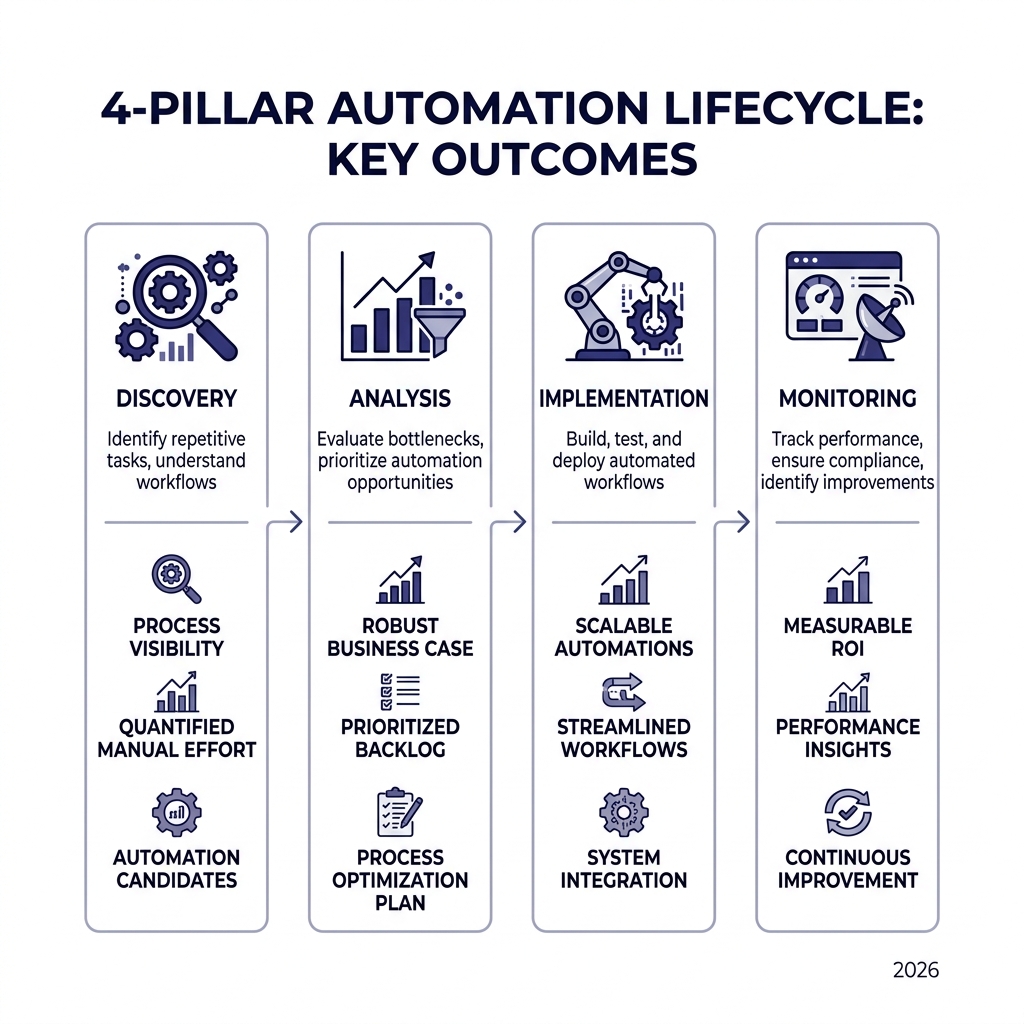
Identifying Candidates for Automation Process Improvement
We use the 4-Factor Filter to decide what to automate first:
High Frequency: Does this task happen 20+ times a week?
Rule-Based Logic: Can you write down the steps clearly?
Structured Data: Is the information digital and organized?
Stability: Is the process unlikely to change in the next six months?
Measuring Success and Sustaining ROI
Most organizations see a positive ROI within 6-12 months. We track Key Performance Indicators (KPIs) like throughput and cycle time to prove the value. A well-executed program can deliver a 200-400% ROI over 18 months. But the work doesn't stop at deployment; we must establish continuous improvement loops to ensure the automation stays aligned with the business as it grows.
Overcoming Challenges: Change Management and Integration
The biggest hurdle isn't the technology—it's the people. Resistance to change is natural. We address this using the 5 C's of Change Management:
Communicate: Explain the "why" early and often.
Champions: Find internal leaders to advocate for the new way of working.
Clarify: Show employees that automation removes drudgery, it doesn't remove people.
Capability: Provide the training and upskilling needed to work alongside new tools.
Celebrate: Highlight the wins to build morale.
Bridging the Gap Between Business and IT
We often recommend establishing a Center of Excellence (CoE). This cross-functional team ensures that automation projects align with both technical standards and business goals, preventing the "shadow IT" that creates technical debt.
The Role of ERP and CRM in Scalable Automation
Your ERP (like NetSuite) and CRM (like Salesforce) are your systems of record. They provide the centralized data needed for automation process improvement. Without a clean master data management strategy, your automations will be working with "dirty" data, leading to incorrect outcomes.
Frequently Asked Questions about Automation Process Improvement
What is the difference between process automation and process optimization?
Automation is the tool used to execute a task. Optimization is the strategy of making the entire workflow as effective as possible. You can automate a bad process, but you must optimize it to truly see a benefit.
How long does it typically take to see ROI from automation?
Quick wins like invoice processing often show ROI in 3-6 months. More complex, enterprise-wide transformations typically take 6-12 months to reach a break-even point.
Will automation eliminate jobs or just change them?
In our experience, automation eliminates tasks, not jobs. By removing the manual "grunt work," employees are freed up for higher-value activities like problem-solving, customer relationship building, and strategic planning.
Conclusion
The path to scaling a mid-sized business in today's market is paved with automation process improvement. It is a journey of continuous improvement, starting with a clear understanding of your current workflows and ending with a scalable, digital-first operation.
At THG Advisors, we bring decades of experience to help you navigate this transformation without the typical pitfalls. Whether you are in Atlanta or anywhere across Georgia, we are ready to help you build a foundation for lasting success. Ready to take the first step? Schedule a consultation for Transformation Readiness and Operating Model Design and let's discuss how we can turn your manual bottlenecks into competitive advantages.