

The Expert Guide to Mastering Change Management Processes
Why Change Management Process Experts Are Critical to Transformation Success
Change management process experts are specialists who guide organizations through structured transitions — helping people adopt new systems, strategies, and behaviors so that change actually sticks.
Leading experts in the field utilize structured methodologies to ensure that the "people side" of change is managed with the same rigor as the technical side. These frameworks range from individual adoption models to enterprise-wide cultural transformations.
The stakes are high. Three out of four large-scale transformations fail to meet their objectives. That is not a small risk — that is the default outcome without the right guidance.
But here is the flip side: organizations that apply effective change management are 6 times more likely to meet their project goals. The difference between failure and success is rarely the strategy itself. As one leading methodology puts it, strategies don't fail — adoption does.
Change breaks down at the human level. When people don't understand what is changing, why it matters, or what is expected of them, they revert. They resist. Projects stall. Investments go to waste.
That is exactly what change management process experts are built to prevent.
I'm Walt Carter, President and COO of THG Advisors, with over 30 years of experience leading digital transformation and change management across Fortune 100 organizations, C-suite roles, and global enterprise programs. My work sits at the intersection of technology, strategy, and the human side of change — the same space where the best change management process experts operate every day. In this guide, I'll break down the frameworks, experts, and practical steps that separate transformations that succeed from those that don't.
(1)_compressed.webp?alt=media&token=e9efffd9-122d-4b60-a560-db3283386ab5 "Five stages of change management process with key actions and outcomes at each phase - change management process experts")
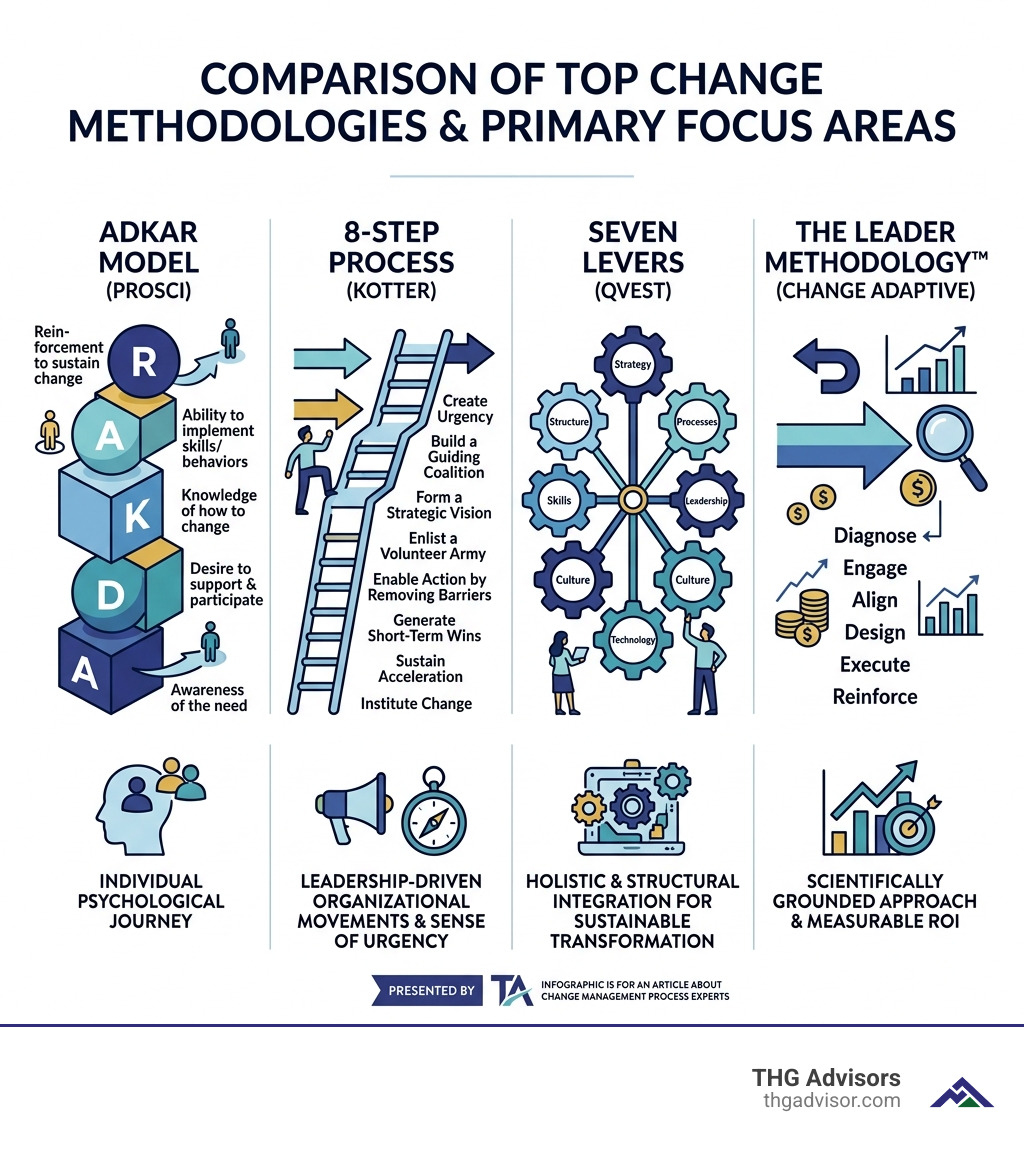
The Core Frameworks Used by Change Management Process Experts
When we look at how change management process experts consistently drive results, we see they don't just "wing it." They rely on battle-tested frameworks that turn the chaotic nature of human behavior into a predictable science. At THG Advisors, we emphasize that Transformation Readiness and Operating Model Design is the foundation of any successful shift. Without a structured framework, you are essentially building a house on sand.
The ADKAR Model
This is perhaps the most widely recognized tool in the industry. It focuses on the fact that organizational change only happens when individuals change. The acronym stands for:
Awareness of the need for change.
Desire to support and participate in the change.
Knowledge of how to change.
Ability to implement required skills and behaviors.
Reinforcement to sustain the change.
The 8-Step Process
This methodology is synonymous with leadership-driven change. It focuses on creating a sense of urgency and building a "guiding coalition." It is less about the individual's psychological journey and more about mobilizing a massive movement within the organization to break down barriers.
The Seven Levers
Some experts take a more holistic, structural view, utilizing seven organizational levers to ensure a transformation is sustainable. These include strategy, structure, processes, leadership, culture, skills, and technology. By addressing all seven, they ensure that the "people side" isn't just a side-car to the "strategy side," but fully integrated.
The LEADER Methodology™
This ROI-focused framework is built on the belief that "change theater"—performative meetings and emails—doesn't work. Instead, it uses a scientifically grounded approach to ensure enterprise-scale adoption. It focuses on removing barriers and providing predictable reinforcement, ensuring that the technology or process being implemented actually gets used.
Human-Centric Methodologies from Change Management Process Experts
In our experience across Georgia and the wider US, we have seen that the most technically perfect strategy will fail if you forget the "heart." Change management process experts are increasingly moving toward human-centric methods that prioritize Leadership Capacity and Cultural Enablement.
The "Head, Heart, and Hands" Approach
Research from top consulting firms shows that transformations are 96% more likely to succeed when leaders engage three specific areas:
Head: Providing a clear, logical vision and strategy.
Heart: Inspiring employees and making them feel supported and seen.
Hands: Giving people the tools and executional certainty to do the work.
Movement Making
Some experts use a methodology called the Art of Movement Making™. Instead of a top-down mandate, they treat change like a grassroots movement. By using Organizational Network Analysis (ONA), they identify the "hidden influencers" in your company—the people everyone goes to for advice, regardless of their title. When these influencers adopt the change, it reaches a "tipping point" where adoption becomes self-sustaining.
Behavioral Science
Experts focus on the actual science of how teams interact. They specialize in converting "hostiles" into collaborators. This isn't just about being nice; it’s about understanding brain science and how to lower the "threat response" that naturally occurs when someone's routine is disrupted.
Agile and Technology-Driven Approaches by Change Management Process Experts
The world doesn't stand still, and neither does change. We are moving away from "one-and-done" transformations toward what experts call "always-on" transformation. This is particularly relevant when we discuss Adaptive Team-Centric Management in an era of rapid AI integration.
Modern change management process experts integrate technology in two ways:
AI Integration: Using AI to track sentiment, measure adoption in real-time, and provide personalized training.
Agile Practices: Moving away from 3-year roadmaps (which are often obsolete by year two) toward iterative, 90-day sprints.
For mid-market companies in Atlanta and beyond, the cost of a full-time executive to lead these complex shifts can be prohibitive. This is where The Value of Hiring a Fractional CXO becomes clear. You get the expertise of a seasoned leader who has seen these patterns before, without the $500k price tag.
Essential Steps in a High-Impact Change Management Process
While every firm has its own "secret sauce," most effective processes follow a similar five-stage journey. At THG Advisors, we believe that Strategic Executive Alignment and Organizational Reframing is the critical first step that many organizations skip.
1. The Preparation Phase
Before you announce anything, you must assess your readiness. Change management process experts look at the organization's history with change. Have past projects failed? Is there "change fatigue"? During this phase, you build the "why" and ensure the leadership team is speaking with one voice.
Key Action: Conduct a Change Readiness Assessment.
Expert Tip: Use an "IT Maturity & Opportunity Audit" to find the quick wins that build momentum.
2. Strategic Planning
This is where the roadmap is built. You define your Change Champions, your communication plan, and your training schedule. Experts emphasize creating "adoption dashboards" during this phase so you know exactly how you will measure success later.
3. Implementation and Execution
This is where the "rubber meets the road." You launch the new system or process. However, the launch is just the beginning. Experts suggest using "Radically Human Communications"—authentic storytelling that connects the change to the company's purpose—to keep engagement high.
4. Making it Stick (Sustaining Results)
This is where most projects fail. The "go-live" happens, the consultants leave, and everyone slowly goes back to their old ways. Experts use reinforcement mechanisms like rewards, updated job descriptions, and continuous feedback loops. Local experts focus on embedding these new behaviors into the local culture.
5. Analysis and Review
Finally, you must look at the data. Did you meet the KPIs? What were the lessons learned? This phase ensures that the organization gets better at change over time.
Measuring Success and Overcoming Resistance in Transformations
How do you know if your change management process experts are actually delivering value? You measure it.
ROI and Adoption Metrics
Success isn't just "finishing the project." It's achieving the business outcomes you promised.
Adoption Rate: What percentage of employees are using the new tool? (Experts can often move this from 40% to over 75% in just a few months).
Proficiency: Are they using it correctly, or are they finding "workarounds"?
Speed of Adoption: How quickly did the organization get back to full productivity?
Managing Resistance
Resistance is a natural human reaction to perceived loss—loss of control, loss of status, or loss of routine. Experts focus on identifying "resistance hotspots" early.
The Solution: Don't ignore the resistors. Give them a voice. Often, their resistance is based on valid concerns about workflow inefficiencies that the "Head" of the project missed.
For organizations needing temporary high-level leadership to navigate these waters, Interim and Fractional Executive Placements provide a way to stabilize the ship while the change is being implemented.
Validating Expertise: Certifications and Professional Standards
If you are looking to hire change management process experts, you should look for specific credentials that validate their expertise.
The CCMP™ Certification
The Certified Change Management Professional™ (CCMP™) is the global standard, managed by the Association of Change Management Professionals® (ACMP®). This certification ensures the practitioner follows "The Standard," a globally recognized body of knowledge developed by thousands of practitioners.
QEP™ Providers
Look for Qualified Education Providers (QEP™). These are organizations whose training programs have been vetted by ACMP to meet rigorous standards.
Professional Associations
In Georgia, the Atlanta chapter of the ACMP is a fantastic resource for finding local experts who understand the specific business climate of the Southeast. These resources provide localized expertise for businesses in our region.
Frequently Asked Questions about Change Management
Why do most large-scale transformations fail?
As we've noted, 75% of transformations fail. The primary reasons are a lack of visible leadership commitment, a failure to address the underlying culture, and a lack of "Heart." If employees feel the change is being done to them rather than with them, they will subconsciously (or consciously) sabotage it.
How do experts ensure long-term adoption?
They use reinforcement. This includes everything from "Change Champion Networks" (internal influencers) to clear communication strategies that keep the "why" front and center long after the initial excitement has faded.
What skills define a top change consultant?
A top expert needs a mix of "hard" and "soft" skills:
Strategic Thinking: To align the change with business goals.
Empathy and Active Listening: To understand and mitigate resistance.
Resilience: To stay the course when things get messy (and they always do).
Collaboration: To work across silos and bring disparate teams together.
Conclusion: Making Change Your Competitive Advantage
Change is no longer a "project" with a start and end date. It is a constant state of being for modern businesses. Whether you are navigating a merger, implementing a new ERP, or trying to figure out how AI fits into your workflow, the quality of your change management process experts will determine your success.
At THG Advisors, we specialize in helping mid-market companies ($10M–$250M revenue) achieve world-class results without the overhead of a full-time C-suite hire. Our THG Strategic CIO Catalyst Program is designed to turn your technology from a cost center into a growth engine.
We offer a 60-Day “Transform or It’s Free” Guarantee. If we don’t identify and deliver opportunities worth at least 5x your investment in the first 60 days through strategy, savings, or risk reduction, you pay nothing.
Ready to make technology your unfair advantage? More info about transformation readiness and operating model design is just a click away. Let's build a future-ready organization together.
Book your Complimentary IT Maturity & Opportunity Audit today at thgadvisor.com/book-consultation.