


The CIO Handbook: Mastering the Art of Information Leadership
What Is a Chief Information Officer — and Why It Matters for Your Business
A chief information officer is the senior executive responsible for managing, implementing, and aligning an organization's information technology with its broader business goals.
Here's a quick snapshot:
What they do Lead IT strategy, cybersecurity, digital transformation, and technology investment Who they report to Typically the CEO (41%), CFO (23%), or COO (16%) Key skills Strategic planning, leadership, communication, technical acumen Median total pay ~$321,000/year Job growth 15% projected from 2022 to 2032
The role has come a long way from managing servers and help desks. Today's CIO sits at the intersection of technology and business strategy — shaping how organizations compete, grow, and survive in a digital-first world.
Most enterprise technology failures are not technology problems. They are strategy problems. Unclear outcomes, misaligned governance, and competing priorities derail more transformations than bad code ever will. That is exactly why the CIO role has become one of the most critical — and most complex — positions in any organization.
Whether you are exploring what a CIO does, considering hiring one, or building your own path to the C-suite, this guide covers everything you need to know.
I'm Walt Carter, President and COO of THG Advisors, and I've held the chief information officer role myself — alongside COO, CMO, and CDO positions — across major organizations spanning finance, media, and professional services. That experience is the lens through which this entire guide is written.
Defining the Chief Information Officer: Role and Evolution
At its core, the chief information officer (CIO) is the bridge between technology and the business mission. While an IT Director might focus on keeping the servers running, the CIO focuses on why those servers exist in the first place. We view the CIO as the primary steward of an organization’s information resources, ensuring that every dollar spent on technology returns measurable value to the enterprise.
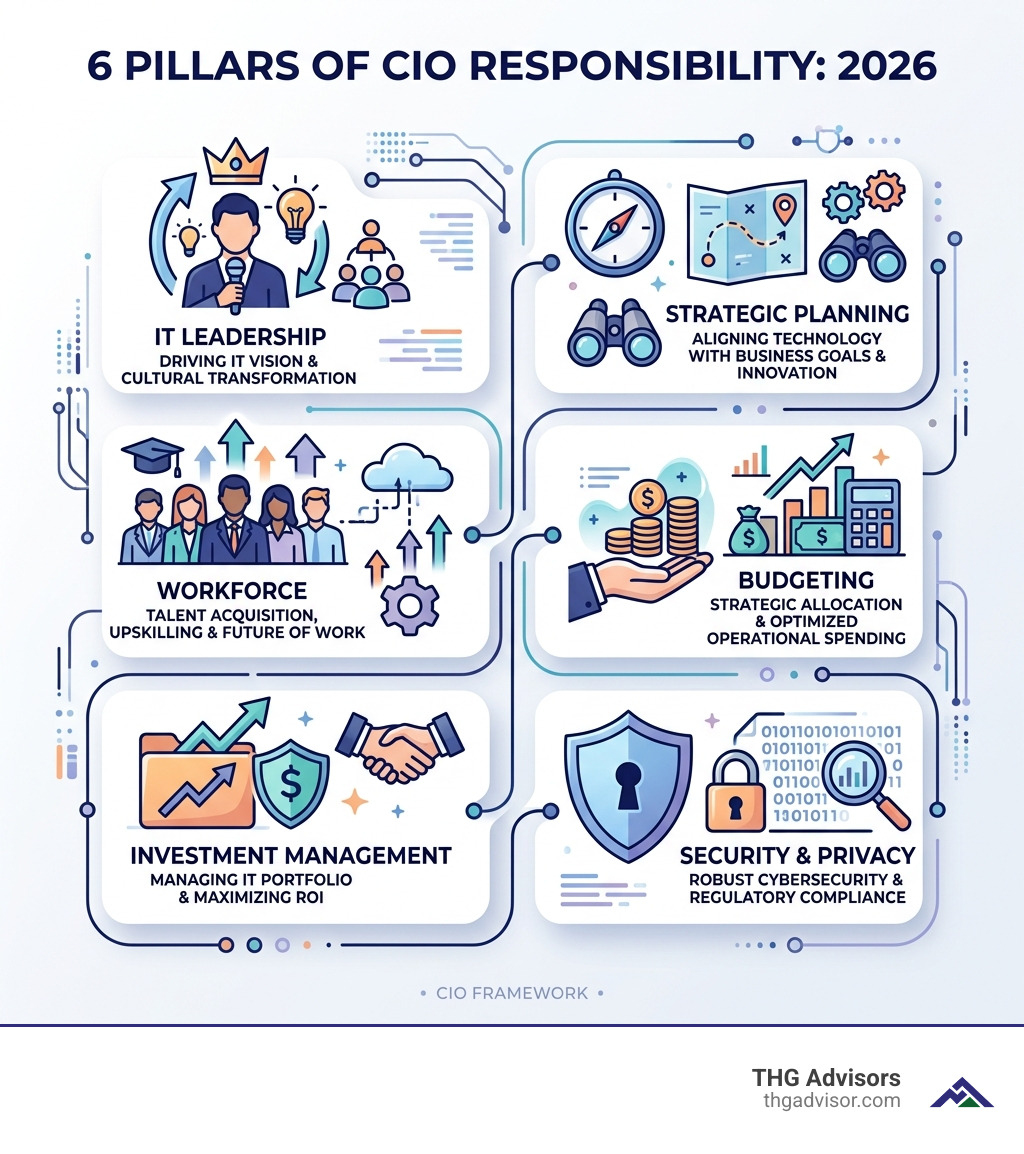
The role involves high-level accountability for six key areas: IT leadership, strategic planning, workforce development, budgeting, investment management, and information security/privacy. In the public sector, this role is so vital that it is often mandated by law. For example, Gregory Barbaccia - Federal Chief Information Officer | CIO.GOV oversees the implementation of secure, high-performing technology across the entire federal government, illustrating the massive scale this position can reach.
The Modern Chief Information Officer as a Decision Architect
We are seeing a profound shift in what it means to lead IT. The modern CIO is no longer just a "technologist"; they are an architect of enterprise decisions. Research shows that most digital transformations stall not because the software failed, but because of organizational and operating model constraints.
A successful CIO must ensure "decision integrity." This means creating outcome clarity, defining clear decision rights, and enforcing tradeoff discipline. Without these, even the best technology will fail to deliver results. At THG Advisors, we specialize in helping leaders navigate these hurdles through Transformation Readiness and Operating Model Design, ensuring your structure supports your digital ambitions rather than hindering them.
Legislative Evolution of the Chief Information Officer
The CIO role didn't just appear; it evolved through necessity and legislation. In the federal space, the Clinger-Cohen Act of 1996 first established agency CIO positions to improve IT investment focus. Later, the Federal Information Technology Acquisition Reform Act (FITARA) enhanced the CIO’s strategic power, positioning them as a direct partner to agency heads for modernization.
Cybersecurity mandates like FISMA have further shaped the role, requiring CIOs to designate senior security officials (often the CISO) to protect national interests. Leaders like Clare Martorana, who served as the 5th Federal CIO, have been instrumental in advancing Zero Trust architecture and improving the digital customer experience for millions of citizens.

The Path to the C-Suite: Qualifications and Career Trajectory
Becoming a chief information officer is rarely a linear path. It requires a unique blend of technical "table stakes" and high-level business acumen. Most prospective CIOs spend at least 10 years in the field before reaching the C-suite, moving from technical roles into mid-level management.
Education is the foundation. A bachelor’s degree in computer science, IT, or business administration is standard, but an MBA or a Master’s in IT Management is often what separates candidates at the executive level. For those in the public sector, specialized training like the Certified Government Chief Information Officer - UGA program is highly regarded. At THG Advisors, we support the next generation of leaders through our Emerging CIO Council, where aspiring executives can gain the peer insights and mentorship needed to make the jump.
Essential Skills for a Successful Chief Information Officer
While technical expertise is important, it is often the "soft" skills that determine success. In fact, 53% of IT leaders report a shortage of managers with high-level personal skills like communication and leadership. Essential skills include:
Change Management: The ability to lead an organization through the friction of digital shifts.
Strategic Planning: Aligning IT roadmaps with 2-year and 5-year business goals.
Interpersonal Skills: Translating complex tech "speak" into business value for the Board.
Technical Acumen: Staying current on AI, cloud, and cybersecurity trends to predict future needs.
For many mid-market companies, finding this full skill set in one person is expensive. This is why many are exploring The Value of Hiring a Fractional CXO to get veteran leadership without the full-time overhead.
Becoming a Chief Information Officer: A Step-by-Step Roadmap
Foundational Experience: Start as a systems analyst, network admin, or developer.
Mid-Level Management: Transition to IT Manager or Director, focusing on team leadership.
Continuous Learning: Obtain certifications like CISSP (security), ITIL (service management), or Six Sigma (process improvement).
Executive Presence: Focus on budgeting, vendor negotiation, and strategic alignment.
Strategic Impact: How CIOs Drive Enterprise Value
The CIO is the engine room of enterprise value. They don't just spend money; they invest it to drive growth. Whether it’s managing a $600 million budget like David Shive at the GSA or overseeing global architectures for the Intelligence Community Chief Information Officer, the goal is the same: mission enablement.
Modern CIOs are currently navigating three massive shifts:
AI Integration: Agencies and companies are finding thousands of ways to use AI to advance their missions.
Cloud Migration: Moving from legacy "on-prem" hardware to agile, scalable hybrid cloud environments.
Cybersecurity: Implementing Zero Trust models to protect data in an increasingly hostile digital landscape.
Navigating the C-Suite: CIO vs. CTO vs. CISO
Confusion often exists between these roles. Here is how we break them down:
Role Primary Focus Key Stakeholders CIO Internal systems, ROI, business efficiency Employees, Board, CEO CTO External products, tech innovation, competitive edge Customers, Engineering teams CISO Data protection, compliance, risk mitigation Legal, Regulatory bodies, IT
Success requires these roles to be in lockstep. We often work with leadership teams on Strategic Executive Alignment and Organizational Reframing to ensure the CIO and CTO aren't pulling the company in two different directions.
Market Outlook: Salary, Growth, and Real-World Leadership
The demand for chief information officer talent is skyrocketing. The U.S. Bureau of Labor Statistics projects 15% growth for computer and information systems managers through 2032—much faster than the average for all occupations.
The compensation reflects this demand. While the median annual pay for IT managers is around $164,070, the total compensation for a CIO often ranges between $245,000 and $428,000, with a median of $321,000. In high-stakes environments like the USPS, leaders like Pritha Mehra manage infrastructures that process 110 petabytes of data annually, supporting 650,000 employees.
Real-World Examples of Information Leadership
Leadership looks different depending on the organization's scale:
Federal Level: Agencies have reported over 1,700 AI use cases in 2024 alone, showing how CIOs are pushing the boundaries of automation.
State Level: In Michigan, CIO Laura Clark manages a 5,000-person team and recently secured $20 million for statewide cybersecurity.
Private Sector: CIOs are increasingly coming from business backgrounds, spending 60% of their time on day-to-day IT activities while steering the ship toward digital maturity.
Frequently Asked Questions about the Chief Information Officer
What is the primary difference between a CIO and a CTO?
The CIO is usually focused internally—improving business processes, managing the IT budget, and ensuring the company's internal tools work efficiently. The CTO is usually focused externally—developing the technology products the company sells to customers and staying ahead of market trends.
What are the most common certifications for aspiring CIOs?
Aspiring CIOs often hold the CISSP (Certified Information Systems Security Professional) for security, ITIL for service management, PMP for project management, and CGEIT for the governance of enterprise IT. Six Sigma is also popular for leaders focused on process improvement.
How is AI changing the role of the CIO?
AI is shifting the CIO from a "resource manager" to a "strategic predictor." CIOs must now govern data ethics, manage AI transparency, and identify which of the 1,700+ potential AI use cases (as seen in federal agencies) will actually drive ROI for their specific business.
Conclusion: Making Technology Your Unfair Advantage
The role of the chief information officer has never been more challenging—or more rewarding. It is the position that turns "keeping the lights on" into "lighting the way" for the entire company. However, for many growing businesses, the $300k+ price tag of a full-time CIO is a heavy lift.
That is why we created the THG Strategic CIO Catalyst Program. We provide fractional CIO leadership that turns your IT department from a cost center into a growth engine. You get seasoned, C-suite expertise (15-25 hours a month) to handle your strategy, vendor negotiations, and cybersecurity roadmap—without the full-time overhead.
Whether you need a permanent leader or Interim and Fractional Executive Placements to bridge a gap, we are here to help. Within 90 days, we can deliver a clear, board-ready IT roadmap and an empowered team that allows you to focus back on your vision.
Ready to see where your technology stands? Book your Complimentary IT Maturity & Opportunity Audit (a $7,500 value) today at thgadvisor.com/book-consultation. Let’s engineer your competitive edge together.