


How to Spot a Great Digital Strategy Firm
Why Choosing the Right Digital Strategy Consulting Firm Can Make or Break Your Transformation
A digital strategy consulting firm helps businesses plan, build, and execute a roadmap for competing in the digital world — covering everything from AI adoption and data analytics to operating model redesign and change management.
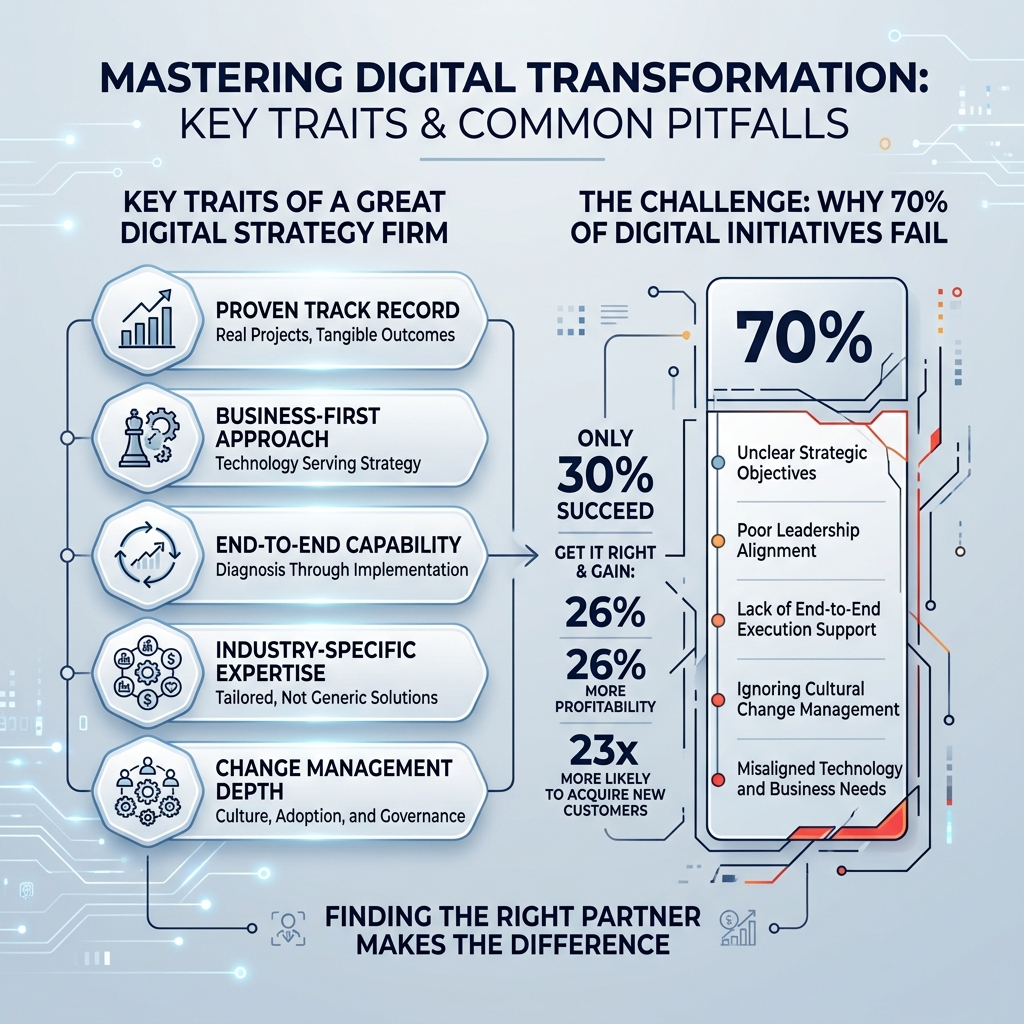
Here's what to look for at a glance:
Proven track record — real projects, real outcomes, not just frameworks
Business-first approach — technology should serve strategy, not the other way around
End-to-end capability — from diagnosis through implementation and governance
Industry-specific expertise — generic advice rarely survives contact with a real market
Change management depth — tools and talent are only part of the equation; culture is the rest
The numbers tell a sobering story. Roughly 70% of digital initiatives fail to meet their objectives. Yet organizations that do get digital transformation right are 26% more profitable than their peers, and data-driven companies are 23 times more likely to acquire new customers.
The gap between those two outcomes often comes down to one thing: the quality of the partner guiding the work.
Not all consulting firms are equal. Some offer polished decks with little execution support. Others bring deep technical depth but miss the human and organizational side. Finding the right fit takes more than a Georgia search — it takes knowing what to look for.
I'm Walt Carter, President & COO of THG Advisors, and with over 30 years leading digital transformation initiatives at organizations like Fidelity, Gannett, and TRW — and having held CIO, COO, CDO, and CMO roles — I've seen what separates a digital strategy consulting firm that delivers real results from one that simply delivers a report. In this guide, I'll walk you through exactly what to evaluate.
Defining the Role of a Digital Strategy Consulting Firm
In the business environment of Atlanta and the broader Georgia market, "digital" is no longer a buzzword—it is the engine of survival. A digital strategy consulting firm acts as the architect of this engine. Their role isn't just to suggest new software; it is to reimagine how your business creates value in a world where data is the new currency.
At its core, a top-tier firm focuses on three main pillars:
Growth Strategies: Identifying new revenue streams. This might mean building a new digital venture outside your core business or using data to find untapped market segments.
Business Optimization: This is the "core wiring." It involves deploying emerging technologies to make your current operations leaner and more responsive.
Digital Acceleration: This is about speed. How quickly can you move from an idea to a pilot to a full-scale rollout?
We believe that a great firm doesn't just look at the technology; they look at the "Market Sensing" capabilities of your organization. Can your business sense a shift in customer habits and pivot before your competitors do? To achieve this, we often focus on Transformation Readiness and Operating Model Design to ensure the internal structure of your company can actually handle the high-speed demands of a digital world.

Core Services of a Leading Digital Strategy Consulting Firm
When you interview a digital strategy consulting firm, you shouldn't just hear about "the cloud." You should hear about a comprehensive suite of services designed to move the needle on your P&L. Here are the "must-haves":
AI Strategy: Beyond the hype of GenAI, a firm should help you build AI solutions that are actually "built for your business." This includes everything from automated customer service agents to predictive supply chain analytics.
Technology, Data, and AI Enablement: Data is the lifeblood of the modern economy. We help clients unlock the power of their data through Technology, Data, and AI Enablement, ensuring that data-driven insights lead to smarter decisions, faster.
Cybersecurity, Risk, and Digital Trust: As you move more operations online, your risk profile changes. A great partner integrates Cybersecurity, Risk, and Digital Trust into the strategy from day one, rather than treating it as an afterthought.
Omni-channel Strategy: Customers today expect a seamless brand experience whether they are on a mobile app, a website, or speaking to a representative in person. Siloed initiatives are the enemy of a consistent customer journey.
Digital M&A and Platform Design: Sometimes the fastest way to grow is to buy. A firm should be able to help you evaluate and execute digital M&A deals or design modular platforms (using APIs and microservices) that allow your business to scale without breaking.
Navigating Challenges with a Digital Strategy Consulting Firm
Why do 70% of digital initiatives fail? It’s rarely because the software didn’t work. It’s usually because the "human operating system" rejected the change. Common hurdles include:
Siloed Initiatives: When Marketing builds one tool and Operations builds another, you end up with "digital chaos."
Legacy Systems: Trying to build a Ferrari engine on a horse-and-buggy chassis.
Talent Gaps and KPI Misalignment: If your team is still being measured by 1990s metrics, they won't embrace 2020s technology.
This is where Strategic Executive Alignment and Organizational Reframing becomes critical. A digital strategy consulting firm must be able to sit down with the CEO and the Board to ensure everyone is pulling in the same direction. They address cultural resistance by putting the "best people in the right places" and fostering an agile mindset where "changeability" is viewed as a competitive superpower.
Proven Frameworks and Methodologies for Success
A great firm doesn't wing it. They use battle-tested frameworks that bring order to the chaos. You might hear terms like TOGAF (The Open Group Architecture Framework) or ArchiMate, which are international standards for ensuring that IT and business goals are perfectly aligned.
One of the most effective methodologies we see in the industry is the "Today Forward, Future Back" approach. It’s a bit like playing chess while running a marathon. You have to win the current mile (Today Forward) while anticipating where the finish line will be in five years (Future Back).
Today Forward vs. Future Back Strategic Planning
Feature Today Forward Future Back Focus Improving the current business model. Reimagining the industry 5-15 years out. Action Operational efficiency and "stepping-stones." Defining "how to win" in a disrupted future. Risk Low risk, incremental gains. High reward, requires bold vision. Goal Immediate ROI and progress. Long-term sustainability and market leadership.
Other firms might use a 6-Step Process that includes:
Digital Strategy Development: Setting the vision.
Discovery: Auditing current tech and data assets.
Readiness Assessment: Measuring if the culture can handle the shift.
Establishment: Building the roadmap and architecture.
Maturity Assessment: Benchmarking against industry peers.
Governance: Ensuring the transformation stays on track over the long haul.
Key Selection Criteria: What to Look For
When you are narrowing down your list of potential partners in the Atlanta area, look past the fancy office and the slick presentation. You need a partner who understands that technology strategy is just a logical extension of business strategy.
1. Industry Expertise & Technical Depth Does the firm understand the specific regulations and customer habits of your sector? A healthcare firm in Georgia has very different needs than a logistics company near the Port of Savannah. You want a team that has been "in your shoes"—ideally led by former C-suite operators who have managed P&Ls, not just consultants who have only ever lived in spreadsheets.
2. Strategic Transactions and Enterprise Value Support Digital transformation is often a precursor to a sale or a major acquisition. Look for a firm that offers Strategic Transactions and Enterprise Value Support. They should be able to tell you exactly how a specific tech investment will increase your company's valuation.
3. Leadership Capacity and Cultural Enablement We cannot stress this enough: Digital transformation is a people project. If the firm doesn't have a plan for Leadership Capacity and Cultural Enablement, the project will likely stall. They should help you upskill your existing team and perhaps provide Interim and Fractional Executive Placements to fill critical gaps while you recruit full-time talent.
4. Ecosystem Partners No firm can do everything. A great digital strategy consulting firm brings a "family" of capabilities—partners in AI engineering, cloud infrastructure, and specialized software. They act as the orchestrator of this ecosystem to ensure you get the best-of-breed solutions without the headache of managing ten different vendors.
Measurable Outcomes and Future Trends
What does success look like? It’s not just "going live" with a new app. It’s about measurable business impact. Research shows that data-driven companies are 58% more likely to beat their revenue goals than those who aren't. In the retail sector, dynamic marketing optimization can deliver a 10%–25% boost in ROI.
As we look toward the future, several trends are shaping how we advise our clients:
Generative AI (GenAI) Integration: Moving from "playing with ChatGPT" to embedding AI into the core operating layer of the company.
Sustainability and ESG: Using data to track and reduce carbon footprints—a growing requirement for global supply chains.
The "Intuitive Enterprise": Moving from being reactionary (responding to customer complaints) to being intuitive (sensing market shifts and shaping them using predictive analytics).
Frequently Asked Questions about Digital Strategy
How do I identify new revenue opportunities through digital?
We recommend starting with your data. By analyzing customer behavior patterns, you can often find "adjacent" needs that your current products don't meet. A digital strategy consulting firm helps you build a "future business" outside your core, using digital ventures or partnerships to test these new markets without risking your main revenue stream.
What is the difference between digital strategy and IT strategy?
Think of it this way: IT strategy is about the "pipes"—the servers, the laptops, and the network. Digital strategy is about the "water"—how you use technology to change your business model, improve customer experience, and grow revenue. IT strategy supports the business; digital strategy is the business strategy in a modern context.
How does a digital strategy consulting firm measure ROI?
We look at both "hard" and "soft" metrics. Hard metrics include increased conversion rates, reduced customer acquisition costs, and operational savings from automation. Soft metrics include "digital maturity" scores, employee engagement with new tools, and the speed at which your organization can now launch new products.
Conclusion
Finding the right digital strategy consulting firm is the most important decision you will make in your transformation journey. When only 30% of companies navigate this shift successfully, you cannot afford to partner with a firm that only understands half of the equation.
At THG Advisors, we pride ourselves on being an operator-led firm. We don't just hand you a strategy; we help with the long-term implementation, governance, and maturity assessments required to ensure those strategies actually take root in your organization. Whether you are looking for Interim and Fractional Executive Placements to lead the charge or need a complete Transformation Readiness and Operating Model Design, our team is ready to help you win.
The future is unfolding faster than ever. Don't let your business get left behind in the "70% failure" category.
Book a Consultation with our experts today or Explore our full range of Services to see how we can accelerate your digital future.