


The Ultimate Guide to Digital Strategy and Advisory
Why Digital Strategy Development Is the Competitive Edge Your Business Can't Ignore
Digital strategy development is the process of creating a clear plan for how your business will use digital technologies to reach its goals, serve customers better, and stay ahead of competitors.
Here is a quick overview of how to develop an effective digital strategy:
Set clear objectives — Define SMART goals tied to your broader business goals
Know your audience — Research customer behaviors, needs, and preferred digital channels
Audit your current state — Evaluate your technology, processes, people, and content
Choose the right channels — Select digital tools and platforms that match your goals and audience
Build your roadmap — Prioritize initiatives with timelines, budgets, and accountability
Measure and adapt — Track KPIs and continuously refine your approach based on real data
Think about brands like Blockbuster, RadioShack, and BlackBerry. They were industry leaders — until they weren't. They ignored digital trends, failed to innovate, and lost everything to competitors who moved faster. On the flip side, companies that committed to smart digital strategies have seen remarkable results: one major sportswear brand now generates over 30% of its total sales online, while a large healthcare organization found that digitally engaged members were twice as likely to stay with them.
The difference between those two outcomes? A focused, well-executed digital strategy.
Most mid-sized businesses know they need to go digital. The hard part is knowing where to start, what to prioritize, and how to make it all work together across marketing, operations, customer service, and technology.
That is exactly what this guide is designed to help you do.
I'm Walt Carter, President & COO of THG Advisors, and over a 30-year career leading digital strategy development as CIO, CDO, CMO, and COO for organizations like Fidelity, Gannett, and TRW, I've seen what separates strategies that drive real growth from those that stall on a slide deck. I'll walk you through the frameworks, decisions, and practical steps that actually move the needle.
The Core Foundations of Digital Strategy Development
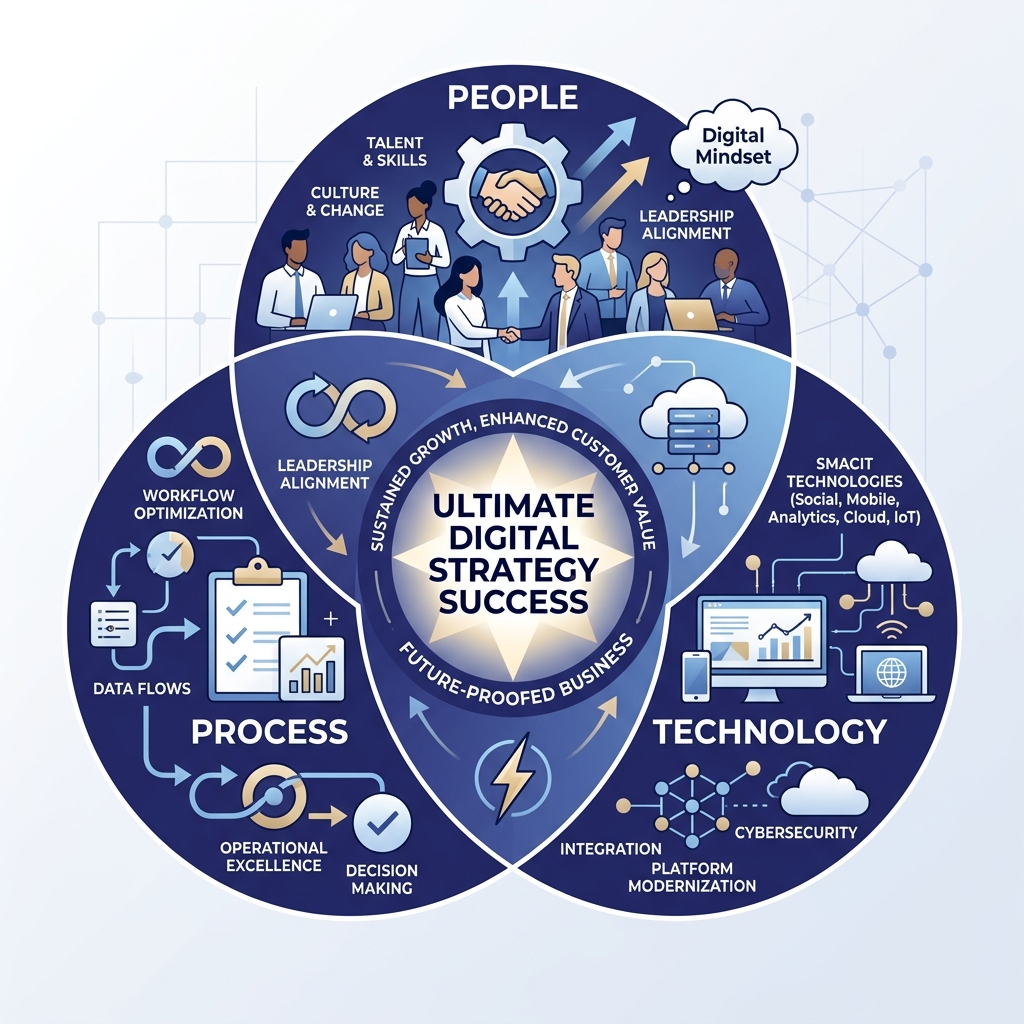
Building a digital strategy isn't just about buying the latest software. If you buy a Ferrari but don't know how to drive or have no roads to drive on, you aren't going anywhere fast. A solid foundation requires a blend of SMACIT technologies—Social, Mobile, Analytics, Cloud, and the Internet of Things (IoT). These are the tools, but the "engine" is your organizational culture and cybersecurity policies.
Research shows that 87% of business leaders believe their industry will be disrupted by digital, yet only 44% feel prepared. To be part of that prepared minority, we must move beyond "doing digital" to "being digital." This means achieving operational excellence where your digital tools aren't just add-ons, but the very way you do business.
Scientific research on digital strategy rules suggests that successful companies don't just "let a thousand flowers bloom." Instead, they focus on two or three high-value use cases. Ambition is key; digital strategies fail more often from a lack of vision than from being too bold.
Aligning People, Process, and Technology
One of the biggest mistakes we see in digital strategy development is focusing 90% of the energy on the "technology" and forgetting the "people" and "process." You can have the best AI in the world, but if your team isn't trained to use it, or if your internal processes are still stuck in 1995, you'll see a zero percent return on investment.
Talent upskilling is mandatory. Your team needs to be data-literate and comfortable with agile operating models. This allows your organization to pivot when the market shifts—which, in the digital world, happens about every fifteen minutes. We focus heavily on strategic executive alignment to ensure that the leadership team isn't just "signing off" on digital, but actually leading the charge.
Building an Operational Backbone
Before you can innovate with fancy apps, you need an operational backbone. Think of this as the "boring but essential" part of your business: standardized processes, data transparency, and rock-solid transaction processing. Without a clean data lake (a central place where all your data lives), your analytics will be "garbage in, garbage out."
A strong backbone ensures that when a customer interacts with you on social media, your sales team knows about it, and your fulfillment team is ready to ship. This requires significant leadership capacity and cultural enablement to break down the silos that usually keep data trapped in different departments.
A Step-by-Step Process for Effective Digital Strategy Development
Creating a strategy shouldn't be a mystery. It follows a logical path from understanding who you are to understanding where you want to go.
Step 1: Set SMART Objectives. "Grow our business" is a wish, not a strategy. "Increase online lead conversion by 15% by Q4" is a SMART goal.
Step 2: Conduct Audience Research. Who is your customer? What "jobs" are they trying to do? Use cross-funnel personas to understand their online behaviors.
Step 3: Competitive Analysis. Use SWOT (Strengths, Weaknesses, Opportunities, Threats) templates to see where your competitors are winning and where they are leaving money on the table.
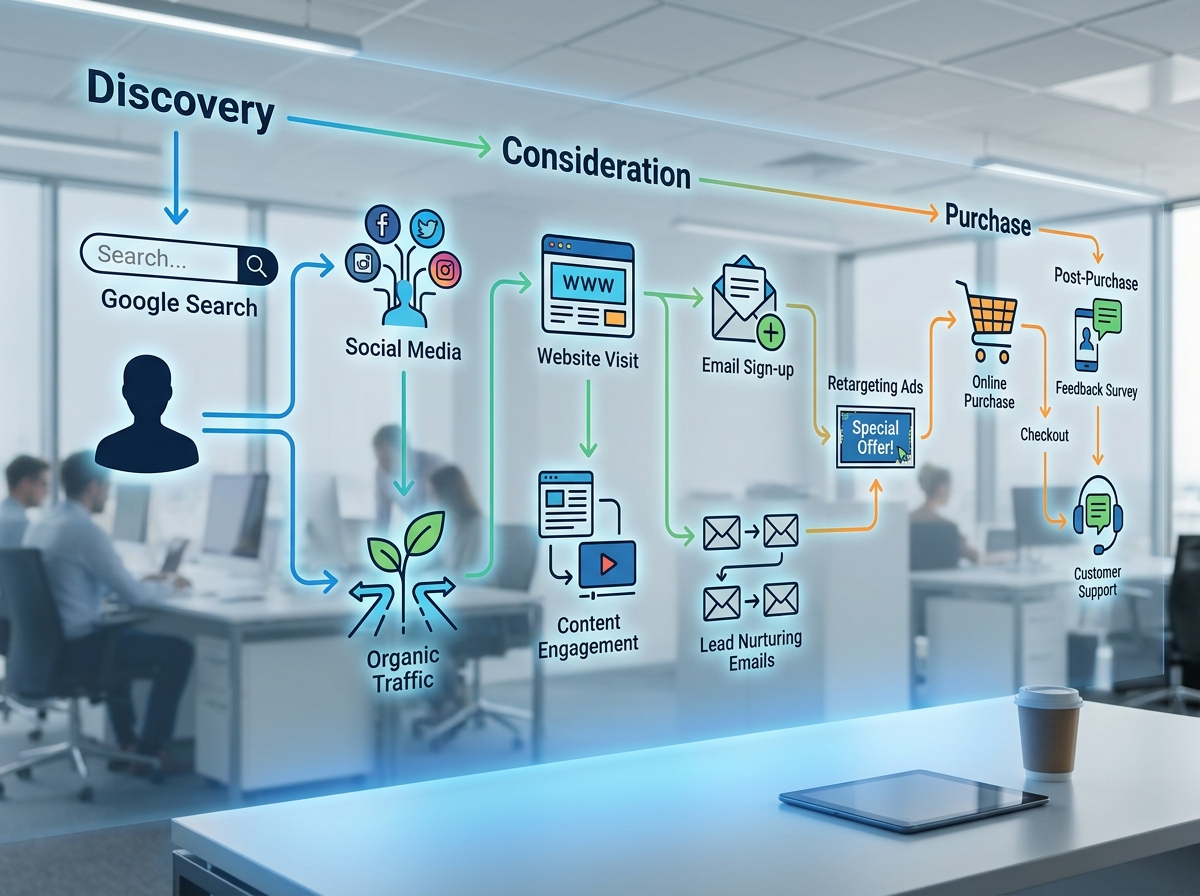
Step 4: Map the Customer Journey. Identify every digital touchpoint, from the first Google search to the final "thank you" email.
Step 5: Select Digital Channels. Don't try to be everywhere. If you are a B2B firm in Atlanta, LinkedIn might be your best friend, while TikTok might just be a distraction.
The Role of Data in Digital Strategy Development
Data is the fuel for your digital engine. Companies like Unilever capture 1.5 terabytes of data daily from over 150 sources to drive their decisions. While you might not be at that scale yet, the principle remains: you must monitor Key Performance Indicators (KPIs) religiously.
Predictive analytics can tell you which customers are about to leave before they even know it themselves. By using data lakes, you can combine information from your website, your CRM, and your social media to get a 360-degree view of your business. For a deeper dive into the academic side of this, check out this scientific research on developing great digital strategies.
Creating an Actionable Implementation Roadmap
A strategy without a roadmap is just a daydream. We typically recommend an 8-12 week timeline for the initial blueprinting phase. This isn't just about what you'll do, but how you'll pay for it.
Resource allocation is where the rubber meets the road. A common benchmark for mature companies is the 55/40/5 ratio:
55% of budget to "Run" (keeping the lights on)
40% to "Grow" (improving existing services)
5% to "Transform" (big strategic bets on the future)
Many legacy companies spend 90% on "Run," which is why they get disrupted. We help businesses shift this balance through transformation readiness and operating model design.
Strategic Frameworks: Engagement vs. Digitized Solutions
When it comes to digital strategy development, you generally have two main paths. Trying to do both at once usually leads to doing neither well.
Customer Engagement Strategy: Focuses on building deep loyalty through personalized, omnichannel experiences. Think of how Starbucks uses its app to make your morning coffee feel like a VIP experience.
Digitized Solutions Strategy: Focuses on information-enriched products and services. Think of John Deere transforming from a tractor company to a data company that helps farmers optimize crop yields.
Feature Customer Engagement Digitized Solutions Primary Goal Loyalty and Trust Product Innovation Key Metric Net Promoter Score (NPS) Revenue from New Services Tech Focus CRM, Social, Mobile IoT, Big Data, AI Value Prop "We know you best" "Our product works smartest"
Applying the Jobs to be Done Framework
To choose the right path, you need to understand the "Jobs to be Done" (JTBD). This framework, popularized by Clayton Christensen, suggests that customers don't just buy products; they "hire" them to do a job.
If you are a bank, the customer isn't "buying a mortgage." They are "hiring" a way to own a home. When you understand the job, you can identify the real pain points and create a value proposition that actually resonates. You can read more in this research on the Jobs to be Done framework.
Integrating AI and Emerging Technologies
AI is no longer science fiction; it’s a standard business tool. From chatbots that handle basic customer service to machine learning algorithms that optimize supply chains, AI is the ultimate multiplier for your digital strategy.
However, AI requires a foundation of clean data. You can't automate chaos. We work with clients to build IoT ecosystems that turn physical assets into data-generating machines, providing real-time insights that were impossible ten years ago. Explore our technology, data, and AI enablement services to see how these tools can be applied to your specific business model.
Measuring Success and Overcoming Implementation Challenges
How do you know if your digital strategy development is working? You look at the numbers. Success often shows up as EBIT (Earnings Before Interest and Taxes) growth. For example, Renault saw a 25% increase in EBIT through their digital strategy pilots.
Other metrics to watch include:
Conversion Rates: Are people actually buying?
Net Promoter Scores: Do your customers like the digital experience?
Digital Maturity: How well is your team adopting new tools?
Overcoming Common Challenges in Digital Strategy Development
It’s not all smooth sailing. The biggest hurdles are usually internal. Siloed departments—where Marketing doesn't talk to IT—can kill a digital project faster than a lack of funding. Legacy systems (those old "computers in the basement") can also hold you back, making it hard to integrate new cloud-based tools.
Change management is the secret sauce. You have to win the hearts and minds of your employees. Look at the research on Nike's digital sales growth; they didn't just build a website; they built a digital culture that empowered their staff and engaged 100 million social media followers.
Ensuring Long-Term Sustainability and Evolution
A digital strategy is not a "one and done" project. It’s a living document. We recommend establishing governance committees that meet regularly to review progress and adjust the roadmap.
Market feedback loops are essential. You should be testing your digital products with real customers early and often to avoid "digital flops." Furthermore, cybersecurity isn't a static policy; it requires constant updates to protect your data and your reputation.
Frequently Asked Questions about Digital Strategy
What is the difference between digital strategy and digital marketing?
Digital marketing is a subset of digital strategy. While marketing focuses on using digital channels (like SEO, social media, and email) to acquire and retain customers, a full digital strategy encompasses your entire business—including operations, supply chain, HR, and how you use data to make decisions.
How do you set clear objectives for a digital strategy?
Start with your business goals. If your goal is to expand into new markets, your digital objective might be to launch a localized e-commerce platform within six months. Use the SMART criteria: Specific, Measurable, Achievable, Relevant, and Time-bound.
Why do most digital strategies fail to meet their goals?
Most fail because of "too little ambition" or a lack of focus. Trying to do too many things at once dilutes your resources. Other common reasons include a lack of executive buy-in, poor data quality, and failing to address the cultural changes needed to support new technology.
Conclusion
At THG Advisors, we believe that digital strategy development is the bridge between where your business is today and where it needs to be to thrive in a hyperconnected world. We provide innovative business solutions by leveraging cutting-edge technologies and our award-winning expertise. With decades of experience driving success for major global brands, we offer the dedicated support you need to navigate this complex landscape.
Whether you are looking to enhance customer engagement or build a digitized solution that disrupts your industry, we are here to help you build the roadmap.
Ready to take the next step? Explore more about our advisory services and let's build your digital future together.