


Why Everyone is Obsessed with Finance and Accounting Process Improvement
Why Finance and Accounting Process Improvement Is Now a Business Imperative
Finance and accounting process improvement is the practice of systematically streamlining financial workflows to reduce errors, cut costs, speed up reporting, and free your team to focus on work that actually drives growth.
Here is a quick overview of what it involves and why it matters:
Area What It Means What it is Reviewing and redesigning accounting workflows to remove waste, manual steps, and bottlenecks Why it matters Slower processes cost money, increase compliance risk, and delay critical business decisions Key methods Standardization, automation (RPA, AI), cloud tools, shared services, and strong data governance Where to start Audit your current processes, identify the biggest pain points, then fix root issues before automating How to measure it Track cycle times, error rates, cost per transaction, and FTE efficiency
Modern finance teams are under real pressure. Regulations keep changing. Competitors move faster. And many businesses are still running critical financial operations on manual processes, disconnected systems, and spreadsheets that were never built for scale.
The result? Slow month-end closes, costly errors, compliance gaps, and finance teams stuck doing repetitive tasks instead of providing strategic insight.
The good news: there is a clear, proven path to fixing this. And it does not require a massive budget or a complete system overhaul to get started.
I'm Walt Carter, President and COO of THG Advisors, and with over 30 years of experience leading digital transformation and operational excellence initiatives for major organizations, I have seen how targeted finance and accounting process improvement can turn a struggled back-office function into a true competitive advantage. In the sections below, I will walk you through exactly how to make that shift.
The High Cost of Inefficiency: Common Pain Points in Finance
When we talk to business leaders in Atlanta and across Georgia, we often hear the same frustrations. Finance departments frequently feel like they are in a constant state of "fire drill" mode. This isn't because the team isn't working hard; it’s because the underlying processes are broken.

The most common pain point is manual data entry. When your team is spending hours typing data from paper invoices into a system, they aren't just wasting time—they are increasing the risk of typos that can lead to massive headaches during an audit. Furthermore, disconnected systems create organizational silos. If your CRM doesn't talk to your accounting software, someone has to bridge that gap manually, leading to duplicated efforts and conflicting data.
These inefficiencies have a ripple effect. Slow reporting cycles mean leadership is making decisions based on data that is three weeks old. In a fast-moving market, that’s like trying to drive a car while only looking in the rearview mirror. Moreover, the impact of manual processes on cash flow can be devastating. If you don't know exactly who owes you money or when it’s due, your liquidity can dry up unexpectedly.
Identifying Bottlenecks in Your Finance and Accounting Process Improvement Journey
To fix a process, you first have to see where it’s leaking. We often look for shadow processes—those unofficial workarounds employees create because the "official" way is too slow or difficult. While these might seem like clever shortcuts, they actually bypass internal controls and create compliance risks.
Other common bottlenecks include:
Information Bottlenecks: Waiting on approvals from managers who are traveling or buried in emails.
Unnecessary Steps: Activities that add complexity but zero value, like printing a digital report just to sign it and scan it back in.
Lack of Awareness: Team members who aren't aware of the most efficient way to use existing tools.
Inconsistent Terminology: When "Revenue" means something different to Sales than it does to Accounting, errors are inevitable.
If your leadership team is stretched too thin to identify these gaps, Interim and Fractional Executive Placements can provide the high-level expertise needed to spot these issues and design a path forward without the cost of a full-time hire.
Core Strategies for Finance and Accounting Process Improvement
Successful finance and accounting process improvement isn't about working harder; it’s about working smarter. According to research, organizations that link more than half of their journal entries directly from internal or external systems complete their monthly statements significantly faster and at a much lower cost.
Feature Manual/Legacy Workflow Optimized/Modern Workflow Data Entry Manual typing, high error risk Automated feeds, system integration Standardization Varies by department or person Global standard Chart of Accounts (COA) Closing Cycle Peak-load "frenzy" at month-end Continuous accounting/pre-close tasks Visibility Siloed, outdated spreadsheets Real-time digital dashboards Internal Controls Person-dependent, manual checks System-enforced, automated audits
One of the most effective strategies is standardization. By implementing a standard Chart of Accounts (COA) and common data definitions, you ensure everyone is speaking the same financial language. About two-thirds of top-performing organizations have already moved to a standard COA to drive efficiency.
Another powerful move is centralizing via shared services. While less than 20% of organizations currently use shared services for general accounting, those that do report faster cycle times and significantly fewer errors. Centralization allows you to apply the best tools and talent to repetitive tasks, achieving economies of scale that siloed departments simply cannot match.
Optimizing High-Impact Workflows: AP, AR, and Month-End Close
If you want to see immediate ROI, start with the most transactional areas. In Accounts Payable (AP), moving from paper to a digital "procure-to-pay" workflow can slash the cost per invoice. In Accounts Receivable (AR), automating the "order-to-cash" cycle ensures invoices go out the moment a deal is struck, directly improving your cash position.
The month-end close is often the biggest source of stress. We recommend moving toward a "continuous close" model. Instead of waiting until the 30th to start reconciliations, perform pre-close activities throughout the month. This evens out the workload and provides leadership with real-time insights. If your business is preparing for a sale or merger, these optimizations provide critical Strategic Transactions and Enterprise Value Support by proving to buyers that your financial house is in perfect order.
Leveraging Automation and Emerging Technologies
Technology is the engine of modern finance. Robotic Process Automation (RPA) is now used by more than half of forward-thinking finance teams to handle repetitive tasks like data extraction and reconciliation.
But it doesn't stop at robots. Artificial Intelligence (AI) and cognitive computing are being rolled out by about 40% of organizations to optimize costs and provide predictive insights. Imagine a system that doesn't just record what happened, but flags an anomaly in a vendor payment before the check is even cut.
Cloud-based ERP systems are also a game-changer, with 58% of survey participants now leveraging the cloud for general accounting. These tools offer the flexibility and accessibility needed for modern, often remote, workforces. Even blockchain technology is gaining traction, with 58% of organizations exploring it to enhance the transparency and security of financial records.
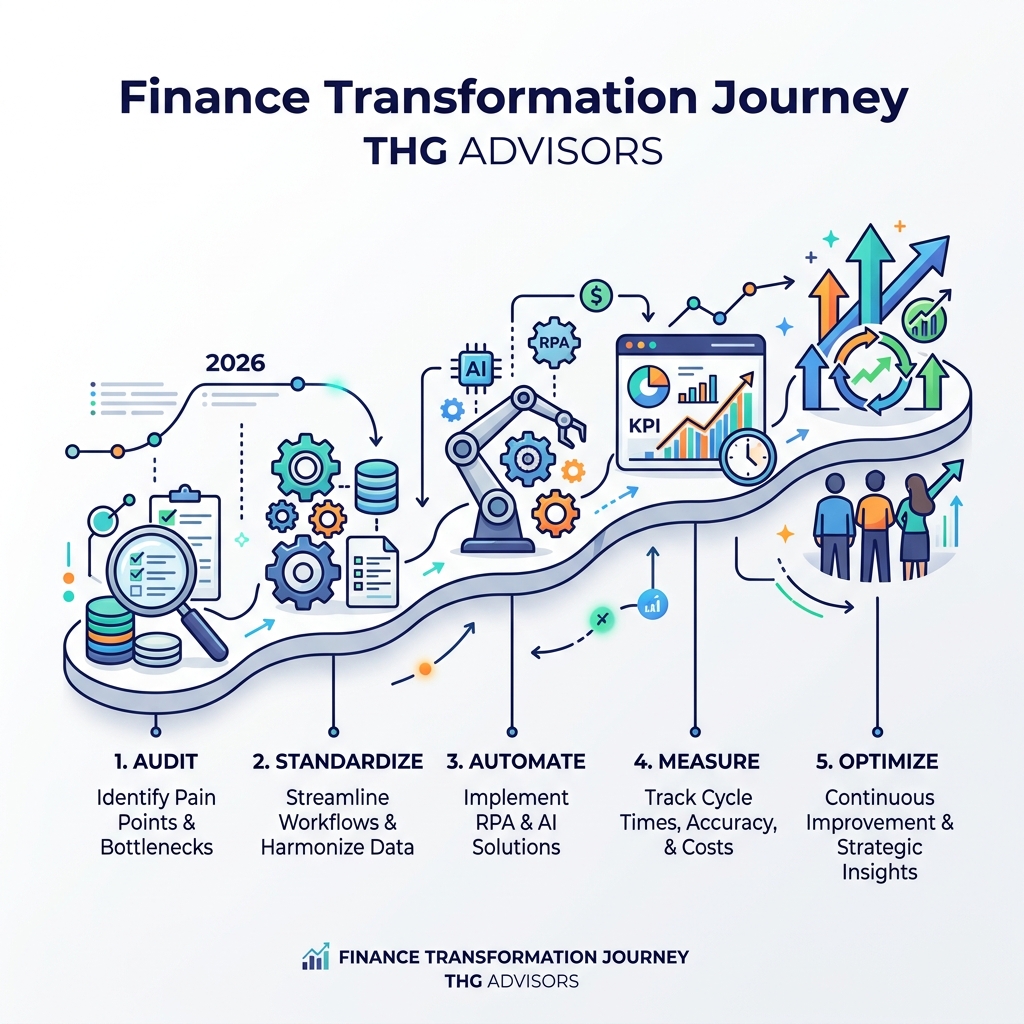
The Implementation Roadmap: From Audit to Optimization
You cannot automate a mess. If you put "lipstick on a pig" by automating a broken process, you just get a faster, more expensive mess. At THG Advisors, we follow a structured lifecycle to ensure lasting change.
Current State Audit: Map out every step of your current workflow. Identify the bottlenecks, the "shadow processes," and the points where data is most likely to be corrupted.
Strategic Planning: Define your goals. Do you want to reduce the close cycle by three days? Lower the cost per invoice by 20%? Set clear KPIs.
Redesign Phase: This is where you whiteboard the "ideal" flow. Use Lean methodology to eliminate waste and Six Sigma principles to reduce variance and errors.
Stakeholder Buy-In: Process improvement is as much about people as it is about software. Involve your team early so they feel ownership of the new way of working.
Implementation & Change Management: Roll out the new process in stages. Provide intensive training and clear documentation.
Optimization: This is not a "one and done" project. Schedule check-ins at 30 days, 90 days, and six months to refine the process based on real-world feedback.
Building a Future-Ready Finance Team through Skills Development
Technology is only as good as the people running it. As we automate the "grunt work," the role of the finance professional shifts from data entry clerk to strategic advisor. This requires upskilling in areas like financial storytelling—the ability to explain why the numbers are moving, not just what they are.
Teams need to master driver-based modeling and variance analysis to provide the nuanced insights leadership needs. We’ve found that structured onboarding can reduce the time it takes for a new hire to reach full productivity from six months down to just two. For many mid-sized companies in Georgia, The Value of Hiring a Fractional CXO lies in bringing in a leader who can mentor the existing team through this transition, ensuring the culture shifts alongside the technology.
Measuring Success: KPIs and Long-Term Benefits
How do you know if your finance and accounting process improvement efforts are working? You have to track the data.
Key metrics to monitor include:
Cycle Time: How long does it take to close the books or process an invoice?
Error Rates: How many journal entries require correction?
Cost per Transaction: What is the total labor and tech cost of processing a single AP or AR item?
FTE Efficiency: How much revenue is the company generating per finance employee?
Beyond the numbers, the long-term benefits are profound. You get audit readiness, meaning the annual audit becomes a non-event rather than a month of panic. You get real-time visibility, allowing you to pivot quickly when market conditions change. For example, understanding your tax position in real-time is vital when considering how Tax Cut Expiration might impact your future capital allocation and planning.
Frequently Asked Questions
How can I start with finance and accounting process improvement?
Start small but impactful. Audit one specific workflow—like travel and expense reports—and identify the low-hanging fruit. Automating just one repetitive task can build the momentum and "proof of concept" needed to tackle larger projects. Always solicit feedback from the people doing the work; they usually know exactly where the problems are.
What are the most common obstacles during implementation?
Resistance to change is the number one hurdle. People often fear that automation means job loss, when it actually means job evolution. Other obstacles include legacy systems that don't play well with new tools and a lack of standardized data. These can be overcome with strong leadership, clear communication, and a "people-first" approach to technology.
How does centralization improve efficiency?
By moving repetitive tasks into a shared services center, you eliminate redundant roles across different business units. This creates economies of scale, allows for better investment in specialized automation tools, and ensures that internal controls are applied consistently across the entire organization.
Conclusion
In today’s competitive landscape, standing still is the same as moving backward. Finance and accounting process improvement is no longer a luxury for the Fortune 500; it is a necessity for any Georgia business that wants to scale sustainably.
By moving away from manual, siloed operations and embracing a culture of continuous improvement, you don't just save money—you gain the clarity and speed needed to win. At THG Advisors, we bring decades of experience and cutting-edge technology to help you navigate this journey. Whether you are looking to fix a specific bottleneck or undergo a full digital transformation, we are here to support your success.
Ready to turn your finance department into a powerhouse of efficiency? Start your journey with Transformation Readiness and Operating Model Design and see the difference that expert-led process optimization can make for your bottom line.