


Fractional CIO 101: Top Benefits Explained
When Technology Strategy Can't Wait: The Case for a Fractional CIO
A fractional CIO is a part-time Chief Information Officer who provides executive-level technology leadership to businesses that need strategic IT guidance — without the cost or commitment of a full-time hire.
Quick answer:
Question Answer What is a fractional CIO? A senior technology executive who works part-time across multiple companies Who needs one? Growing businesses ($10M–$250M+ revenue) without a full-time CIO What do they do? IT strategy, cybersecurity, digital transformation, vendor management, AI governance How much does it cost? Typically a few thousand dollars per month vs. $180K–$500K+ for a full-time hire How fast is the impact? Most businesses see meaningful improvements within 30–90 days
Technology is no longer just a support function. For mid-sized businesses, it's the difference between scaling and stalling.
But here's the problem: a full-time Chief Information Officer costs anywhere from $180,000 to $500,000+ per year in salary alone — before benefits, bonuses, or the 3–6 months it takes to find the right person. And according to Gartner, the average cost of a CIO vacancy is $1.2 million in delayed revenue, missed deadlines, and crisis management.
Most growing businesses are caught in the middle. They've outgrown basic IT support, but they're not ready — or able — to justify a full-time C-suite technology hire.
That's exactly the gap a fractional CIO fills.
I'm Walt Carter, President & COO of THG Advisors, and over a 30-year career holding CIO, COO, CDO, and CMO roles at organizations like Fidelity and Gannett, I've seen what strategic technology leadership does — and doesn't do — for a business. In this guide, I'll break down everything you need to know about the fractional CIO model and why it may be the smartest move your business makes this year.
Defining the fractional CIO: Strategic Leadership for Growing Brands
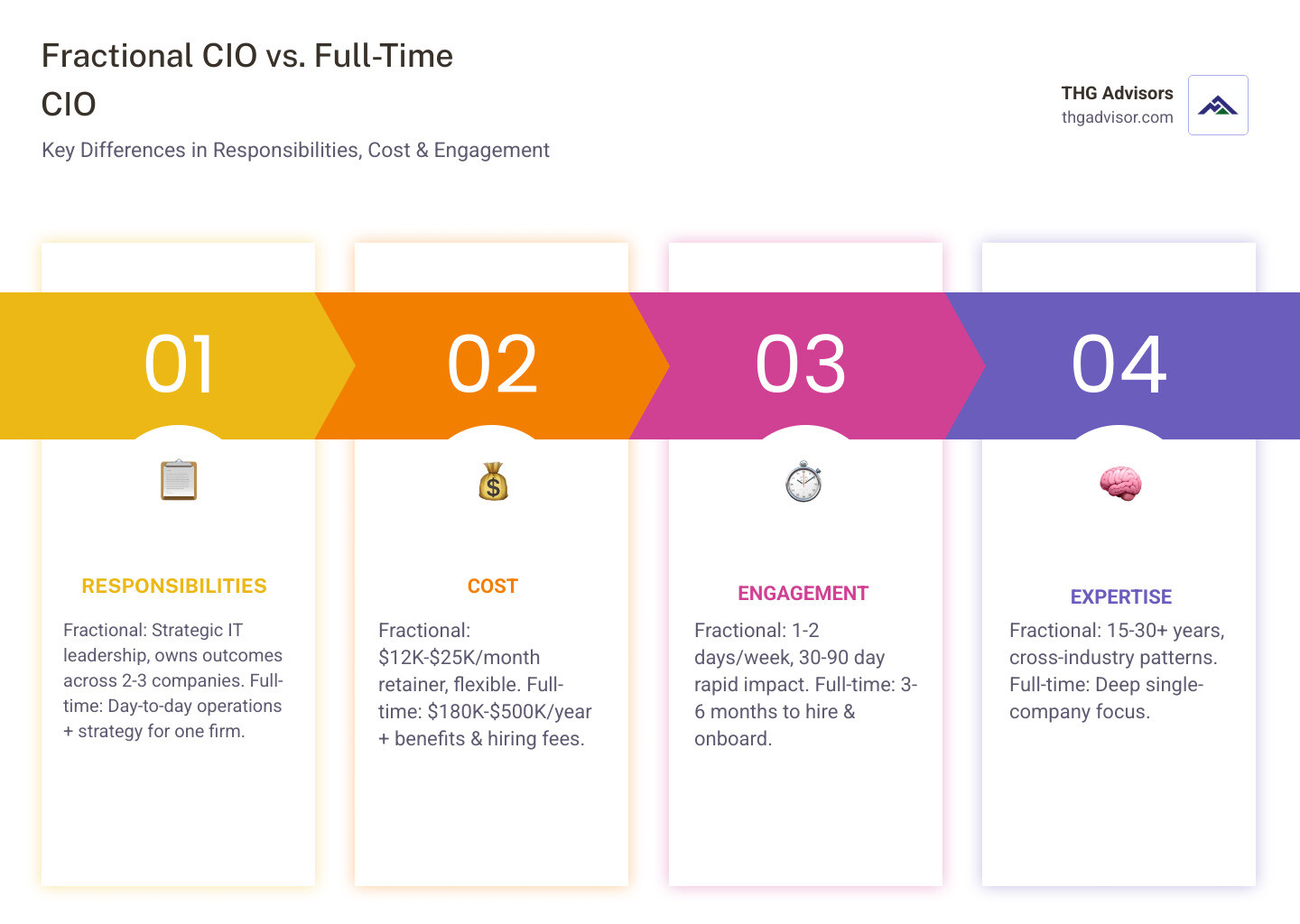
At its core, a fractional CIO is a working member of your executive management team. Unlike a consultant who might drop a 50-page report on your desk and disappear, a fractional leader owns the outcome. They typically serve a small portfolio of 2 or 3 companies, bringing "Board-level" thinking to organizations that are scaling rapidly but aren't yet ready for a $400,000 permanent executive.
We often see businesses in the $10M to $250M revenue range reach a "tech ceiling." Their systems worked fine when they were smaller, but now those same systems are causing friction. A fractional CIO steps in to align business technology strategy with the actual commercial goals of the company. They aren't just "the IT guy"; they are a strategic partner who understands gross margins, EBITDA, and how technology can move those needles.
For a deeper dive into how this fits into the broader executive landscape, check out our guide on The Value of Hiring a Fractional CXO.
Fractional vs. Interim vs. Virtual CIO
The terminology in our industry can get a bit muddy, so let’s clear the air. While these roles share some DNA, the differences are critical for your hiring strategy:
Fractional CIO: This is a long-term, part-time relationship. They are an integral part of your leadership team, often staying for years as the company grows. They focus on long-term architecture and strategic continuity.
Interim CIO: Think of this as a "parachute CIO." They are usually full-time but temporary, brought in to steady the ship during a 6-month gap between permanent hires or to oversee a specific, high-stakes project.
Virtual CIO (vCIO): Often provided by Managed Service Providers (MSPs), a vCIO is frequently more of a "technical account manager." They focus on the health of your servers and tickets. A true fractional CIO, by contrast, has a seat at the executive table and focuses on business transformation.
If you are currently navigating a leadership gap, you might find our overview of Interim and Fractional Executive Placements helpful in deciding which model fits your current "fire."
Why the fractional CIO model is surging
Since 2022, we’ve seen a massive spike in the adoption of fractional roles. Why? Because the world got complicated. Between the AI explosion, remote work shifts, and tightening budgets, businesses need agility.
The "multiple client model" is actually a feature, not a bug. Because our leaders work across different industries, they bring "cross-industry pattern recognition." If a new cybersecurity threat hits the manufacturing sector, we can proactively protect our healthcare clients before it reaches them. It’s a "test-before-you-invest" model that allows for Capex optimization—getting 100% of the wisdom for 20% of the cost.
Core Responsibilities and Strategic Impact
What does a fractional CIO actually do on a Tuesday morning? They own the technology vision. This includes everything from IT governance and KPI reporting to talent development. They make sure your IT team isn't just "fixing printers" but is actually building the platform that will support your next $50M in revenue.
Driving Digital Transformation with a fractional CIO
Did you know that 84% of digital transformation projects fail? It’s a staggering statistic from Forbes. Usually, they fail not because the software was bad, but because the leadership was missing.
A fractional CIO provides the governance needed to beat those odds. They handle:
AI Governance: Establishing guardrails so your team uses AI safely and effectively, rather than it becoming a "science project" that wastes money.
Tech Stack Modernization: Pruning the "software graveyard" of unused subscriptions and ensuring your systems actually talk to each other.
Scalable Architecture: Building a foundation today that won't have to be ripped out and replaced in 24 months.
Cybersecurity and Risk Management
Cybersecurity often feels like Russian roulette for mid-market CEOs. A fractional CIO moves you from reactive fear to proactive management. They implement frameworks like SOC2 or HIPAA compliance and ensure your disaster recovery plan actually works (instead of just sitting in a binder). They also manage "vendor lock-in" risks, ensuring you aren't held hostage by a single supplier's price hikes.
Signs Your Business Has Outgrown Standard IT Support
Many of our clients come to us when they realize their current IT setup is "keeping the lights on" but nothing more. If you're experiencing "strategic paralysis"—where you want to launch a new product but your IT team says it will take 18 months—you've outgrown basic support.
Reactive IT Support (The Old Way) Strategic Fractional Leadership (The THG Way) Focuses on "fixing what's broken" Focuses on "preventing breaks and driving growth" IT is viewed as a cost center IT is viewed as a revenue engine Decisions made by non-technical leaders Decisions made by seasoned C-suite experts Tech debt accumulates quietly Tech debt is identified and systematically removed Vulnerable to $1.2M vacancy costs Instant continuity and leadership
If your systems don't connect, your projects move at a snail's pace, and your IT costs are creeping up without a clear ROI, these are the flashing red lights of tech debt accumulation.
Top Benefits of Hiring a fractional CIO
The most immediate benefit is rapid impact. While a full-time hire might take 90 days just to "learn the culture," a fractional CIO from an elite bench is expected to deliver value within the first 30 to 45 days.
At THG Advisors, our clients routinely see a 10x–20x ROI in the first year. How? Through vendor renegotiations (we often save clients more than our entire fee just by cleaning up contracts), productivity lifts, and avoiding the "expensive mistakes" that happen when non-technical leaders buy the wrong software.
Cost Comparison: Fractional vs. Full-Time Executive
The math is hard to argue with. A top-tier CIO in Georgia or anywhere in the US commands a total compensation package of $300,000 to $500,000+. When you add in the search firm fees (usually 25-30% of first-year salary) and the benefits overhead, it’s a massive commitment.
Our Strategic CIO Catalyst Program provides that same level of expertise for a flat monthly retainer—typically around $12,500. You get 15–25 hours of high-impact leadership per month, which is often exactly what a mid-sized business needs. It provides budget flexibility and the ability to scale hours up or down as your projects evolve.
Selecting the Right Partner for Your Business
Not all fractional leaders are created equal. You aren't just looking for technical expertise; you're looking for commercial acumen. Can they speak "Board-room"? Do they understand how a delay in the supply chain affects your cash flow?
At THG Advisors, we pride ourselves on a rigorous vetting process. In the industry, top-tier executive search standards report that only 1% of candidates make the cut. We look for leaders with 15–30 years of enterprise experience—people who have already "seen the movie" and know how it ends.
Typical Engagement Structure and Deliverables
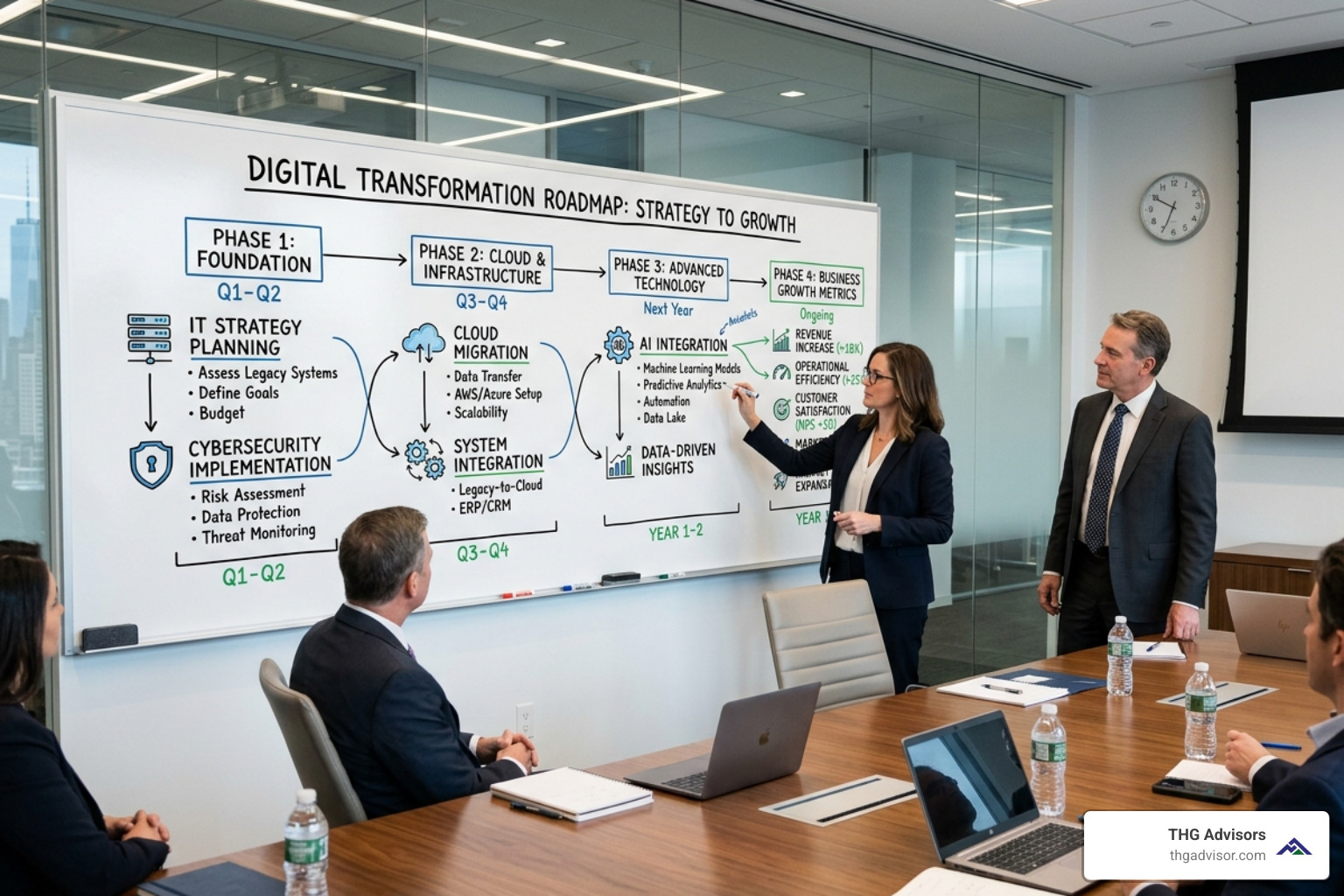
Most of our engagements begin with a 90-day foundation phase. We don't guess; we assess. This usually includes:
IT Health Assessment: A deep dive into your current risks and opportunities.
The Roadmap: A board-ready, 12–24 month strategy aligned with your business goals.
Vendor Negotiation Playbook: Identifying immediate "quick wins" to save money.
We typically embed for 1–2 days a week, attending your executive meetings and providing a "KPI Dashboard" so you finally have visibility into what IT is actually delivering.
Frequently Asked Questions about Fractional CIOs
How much does a fractional CIO typically cost?
While prices vary across the industry, a high-quality engagement typically ranges from $5,000 to $15,000 per month. Our premium "Strategic CIO Catalyst Program" is positioned at $12,500/month, which includes a massive stack of bonuses, proprietary playbooks, and access to our exclusive peer councils.
How quickly can a fractional leader start making an impact?
Speed is one of our greatest advantages. While a traditional search takes 4–6 months, we can typically launch a leader within 7 days. Impact starts on day one with an assessment of your "red zone" risks.
Can a fractional CIO manage my existing internal IT team?
Absolutely. In fact, this is a core part of the role. We mentor your existing staff, helping them move from "firefighters" to "strategic contributors." We provide the leadership they've likely been craving, which often improves retention and morale.
Conclusion
In today’s market, waiting to embed technology leadership is a gamble you don't have to take. An empty CIO seat isn't just a vacancy; it's a $1.2M drain on your potential.
Whether you are dealing with mounting tech debt, the chaos of scaling, or the "Russian roulette" of cybersecurity, a fractional CIO is your greatest growth lever. We turn your IT department from a cost center into a revenue-driving engine.
At THG Advisors, our Strategic CIO Catalyst Program is engineered to remove every obstacle. With our 60-Day "Transform or It’s Free" Guarantee, the risk isn't in hiring us - it's in staying where you are.
Ready to make technology your unfair advantage? Let’s find the "quick wins" in your business.
Transform your IT department into a growth engine with THG Advisors.
-> Go to thgadvisor.com/book-consultation and mention "Strategic CIO Catalyst Program" to book your Complimentary IT Maturity & Opportunity Audit today.