


Fractional CIO Services 101
Why Fractional CIO Services Are Transforming Business Technology Leadership
Fractional CIO services give businesses access to a senior-level Chief Information Officer on a part-time or contract basis — without the cost of a full-time executive hire.
Here's what you need to know at a glance:
Question Quick Answer What is it? A contract-based executive providing strategic IT leadership part-time Who is it for? SMBs, startups, mid-market companies, and non-profits How much does it cost? Typically $3,000–$8,000/month vs. $290,000–$530,000/year full-time Key benefits 65–75% cost savings, flexible engagement, immediate expertise When to consider it During growth, transitions, digital transformation, or a CIO vacancy
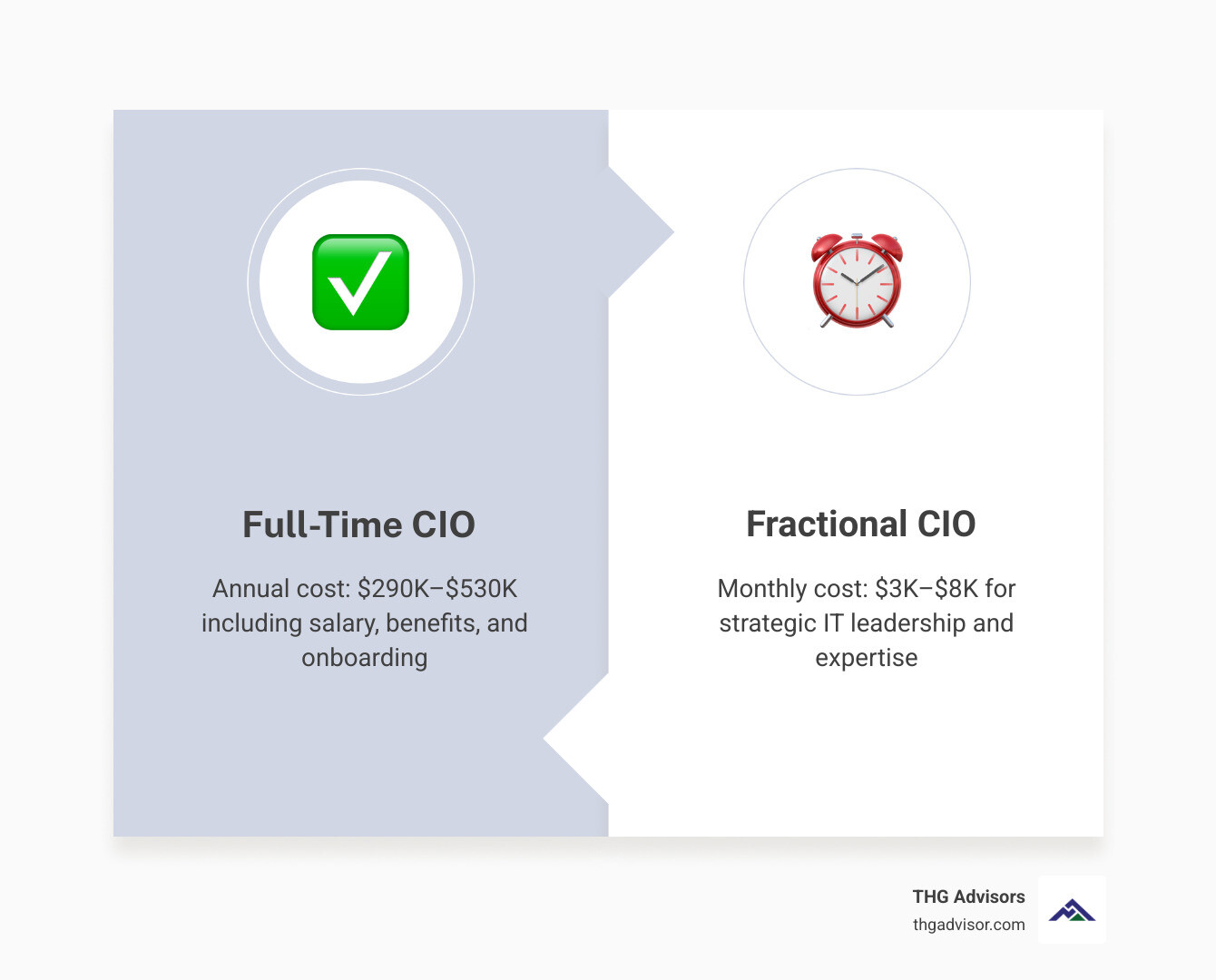
Technology decisions are getting harder. AI, cybersecurity threats, cloud infrastructure, and compliance requirements are all growing more complex — fast. But hiring a full-time CIO costs anywhere from $290,000 to $530,000 per year when you factor in salary, benefits, and onboarding. For most mid-sized businesses, that's simply not realistic.
And leaving the seat empty isn't free either. Research cited by Gartner puts the average cost of a CIO vacancy at $1.2 million — from delayed projects, missed deadlines, and reactive crisis management.
That's the gap fractional CIO services are designed to fill.
I'm Walt Carter, President & COO of THG Advisors, and with over 30 years of experience holding C-suite roles — including CIO, COO, and CDO — at organizations like Fidelity, Gannett, and TRW, I've seen how the right fractional CIO services can transform a business's technology trajectory without breaking its budget. In this guide, I'll walk you through everything you need to know to decide if this model is right for your organization.
Defining the Role: What are Fractional CIO Services?
At its core, a fractional CIO is a contract-based executive who provides strategic information technology leadership and advisory services. Unlike a consultant who might deliver a single report and then disappear, a fractional CIO becomes an integrated part of your leadership team. They carry out the same functions as a full-time CIO but at a "fraction" of the time and cost.
This isn't just about someone who understands computers; it’s about having a seat at the executive table. According to The Value of Hiring a Fractional CXO, these leaders bridge the gap between technical operations and business vision. They ensure that every dollar spent on technology is an investment in your company’s growth, not just an expense to keep the lights on.
Industry experts emphasize that these professionals focus on high-level strategy, digital transformation roadmaps, and vendor management. They step in to assess, align, and accelerate your technology strategy, providing the senior-level insight that smaller and mid-sized companies often outgrow their basic IT support but can't yet justify a full-time executive hire. For a broader overview of the traditional CIO function, see Chief information officer.

Fractional CIO vs. Virtual CIO (vCIO)
It is common to hear the terms "Fractional CIO" and "Virtual CIO" (vCIO) used interchangeably, but there are distinct differences in depth and focus.
A vCIO service, often provided by Managed Service Providers (MSPs), can sometimes be more sales-oriented or focused on the specific tools that the provider sells. In contrast, a true fractional leader provides a deeper level of operational involvement. At THG Advisors, we believe a fractional CIO should be vendor-agnostic and fully embedded in your strategic decision-making process. They aren't just checking a box; they are building a long-term partnership to drive business value.
Distinguishing CIO, CTO, and CISO Roles
When looking for fractional cio services, it's important to understand which "flavor" of leadership you actually need. While the lines often blur in smaller organizations, the roles generally break down as follows:
CIO (Chief Information Officer): Focuses on internal IT operations, infrastructure, governance, and aligning tech with business goals. They ensure systems are reliable and efficient.
CTO (Chief Technology Officer): Generally focuses on external-facing products, innovation, and engineering. If you are building software to sell, you need a CTO.
CISO (Chief Information Security Officer): Dedicated to cybersecurity governance, data protection, and compliance audits.
Many providers offer these as distinct or combined services depending on the company's specific pain points. At THG, our Team includes experts who can wear multiple hats, ensuring your security, operations, and innovation are all moving in the same direction.
The Business Case for Fractional CIO Services
The most immediate argument for the fractional model is the financial one. As of April 2026, the cost of top-tier technology talent continues to skyrocket. Salaries for CIOs have risen more than 20% since 2019.
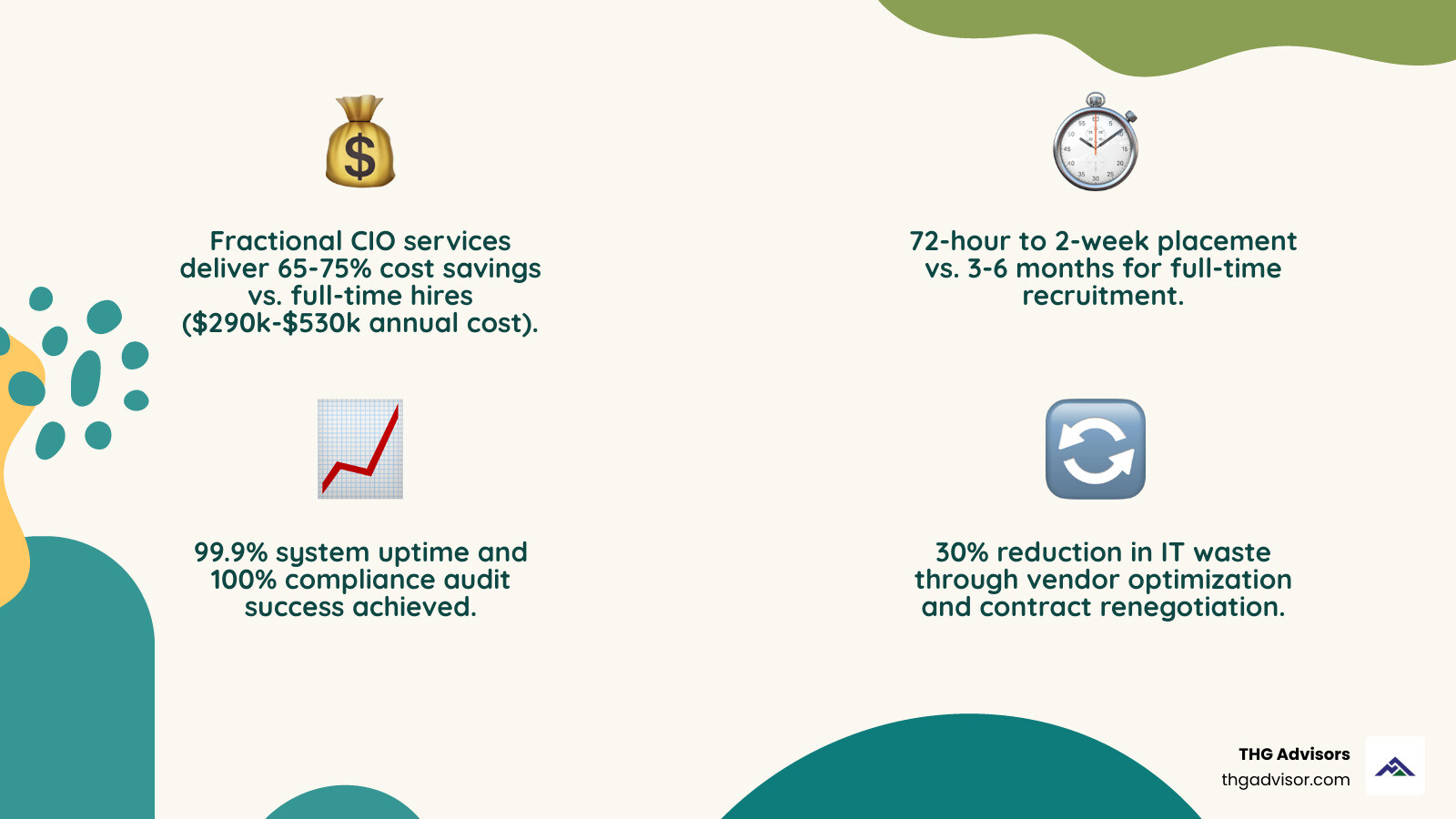
When you hire full-time, you aren't just paying a salary. You are paying for benefits, bonuses, recruitment fees, and the risk that the hire might not work out. fractional cio services typically offer 65% to 75% cost savings compared to a full-time hire.
Feature Full-Time CIO THG Fractional CIO Annual Cost $290k – $530k+ $135k (Typical retainer) Recruitment Time 3–6 Months 72 Hours to 2 Weeks Commitment Long-term Employment Flexible / Month-to-Month Risk High (Severance/Hiring Error) Low (Guaranteed Results)
Beyond the salary savings, there is the "vacancy cost." Gartner reports that a CIO vacancy costs an average of $1.2 million in lost revenue and project delays. Our Interim and Fractional Executive Placements are designed to stop that bleeding immediately.
Who Needs Fractional CIO Services?
We often find that businesses in the $10M to $250M revenue range hit a "tech ceiling." Their current IT team is great at fixing printers and resetting passwords, but they don't have the experience to negotiate a $500k software contract or architect a cloud migration.
Typical candidates for these services include:
SMBs and Mid-Market Companies: Organizations that need enterprise-level strategy but have a mid-market budget.
Non-Profits: Organizations that must maximize every dollar of their budget toward their mission.
Startups: High-growth companies that need to build a scalable foundation quickly to impress investors.
Companies in Transition: Whether you are preparing for an M&A event or recovering from a security breach, senior leadership is non-negotiable.
Measurable ROI and Results
ROI isn't just a buzzword; it's a metric we track. Clients utilizing high-level fractional programs often report:
99.9% system uptime through better infrastructure management.
100% compliance audit success (HIPAA, SOX, GDPR).
30% reduction in IT waste by eliminating redundant software and renegotiating vendor contracts.
10x to 20x ROI in the first year through risk avoidance and productivity gains.
Core Services and Strategic Impact
What does a fractional CIO actually do on a Tuesday morning? They aren't troubleshooting your Wi-Fi. They are looking at the Services that drive your business forward.
Key areas of impact include:
IT Strategy & Roadmap: Creating a 12–24 month plan that aligns technology spend with your actual business goals.
Vendor Management: Taking over the "hard conversations" with software and hardware providers to ensure you aren't being overcharged.
Tech Stack Modernization: Identifying "tech debt" — old systems that are slowing you down — and finding modern, scalable replacements.
KPI Dashboards: Providing the CEO and Board with clear, easy-to-read reports on how IT is performing.
Navigating AI Adoption with Fractional CIO Services
By April 2026, AI is no longer a "future" technology — it's a daily requirement. However, many businesses are adopting AI tools without any governance, leading to massive data risks. A fractional CIO helps you implement AI with a "security-first" mindset. We help you find practical efficiency gains (not "science projects") while ensuring your proprietary data doesn't end up in a public LLM.
Cybersecurity and Risk Management
The threat landscape is more aggressive than ever. A fractional CIO implements proactive frameworks rather than just reacting to the latest virus. This includes everything from staff training to multi-factor authentication (MFA) enforcement and disaster recovery planning. We turn cybersecurity from "Russian roulette" into a managed business risk.

Engagement Process and Team Integration
One of the biggest myths about fractional cio services is that they replace your existing IT team. They don't. In fact, our Team works to empower your current staff. We provide the mentorship and senior-level air cover your internal IT manager needs to be successful.
The typical engagement process looks like this:
Discovery (Days 1-3): A deep dive into your current challenges and business goals.
IT Health Assessment (Weeks 1-2): Identifying immediate risks and "quick win" cost savings.
Roadmap Creation (Weeks 3-8): Building the long-term strategy.
Ongoing Execution: Weekly or monthly sessions to oversee projects and mentor the team.
Choosing the Right Provider
Not all fractional CIOs are created equal. When evaluating a partner, look for:
Industry Fit: Do they understand the specific regulations of your sector (e.g., healthcare or finance)?
Executive Experience: Have they actually sat in the CIO chair at a major company, or are they just a consultant with a fancy title?
Cultural Alignment: Will they mesh with your existing leadership team?
Track Record: Can they point to billions in transaction value or hundreds of successful placements?
Frequently Asked Questions about Fractional CIOs
How much do fractional CIO services cost compared to a full-time hire?
As we've noted, a full-time CIO can cost over $500,000 annually. Fractional cio services typically range from $3,000 to $12,500 per month depending on the level of involvement. This usually results in a 65% to 75% total cost reduction while providing higher-level expertise than a mid-level full-time hire.
How do fractional CIOs integrate with existing IT teams or MSPs?
We act as the "bridge." Your MSP is great at the "doing" (patching servers, help desk), but they often lack the "thinking" (business strategy). A fractional CIO manages the MSP and your internal staff, providing the strategic direction they need to be effective.
What is the typical timeline for starting a fractional engagement?
While a full-time executive search can take 6 months, we can often place a leader and begin making an impact in as little as 72 hours. Most formal onboardings are completed within 7 to 14 days.
Conclusion
In today's environment, technology is either your greatest growth lever or your biggest bottleneck. You cannot afford to leave your IT strategy to chance, but you also shouldn't have to overextend your budget for a full-time executive you only need part-time.
At THG Advisors, our Strategic CIO Catalyst Program is designed to turn your IT department into a revenue engine. We provide the battle-tested leadership of executives like Jimmy McCullough and our elite bench to ensure you have a clear roadmap, reduced risk, and a high-performing team.
Ready to see what enterprise-level leadership can do for your bottom line? Transform your technology with Interim and Fractional Executive Placements today.
Book your Complimentary IT Maturity & Opportunity Audit ($7,500 value) at thgadvisor.com/book-consultation. Let's build your competitive edge together.