


Why Your Business Needs Logistics Management Consulting
When Your Supply Chain Becomes a Competitive Liability
Logistics management consulting helps businesses design, optimize, and transform their supply chains to cut costs, improve delivery performance, and build long-term resilience.
Here is a quick snapshot of what it covers:
Area What Consultants Address Network Design Warehouse locations, distribution routes, plant networks Inventory Deployment strategy, health checks, turnover improvement Transportation Freight optimization, carrier selection, cost reduction Technology WMS, TMS, AI tools, digital transformation roadmaps Performance KPIs, on-time delivery, customer service levels Risk & Resilience Nearshoring, sustainability, geopolitical disruption response
Logistics is the backbone of any product-based business. But for most mid-sized companies, it is also one of the most overlooked sources of hidden cost and competitive disadvantage.
Supply chain problems rarely announce themselves loudly. They start small — a few late shipments, rising freight bills, inventory that just does not move. Then they compound. Customer complaints grow. Costs climb. Market share shrinks.
The stakes are real. Businesses that optimize their logistics operations have achieved results like a 22% reduction in transportation and warehousing costs and dramatic improvements in delivery reliability. Those that do not optimize often find themselves outpaced by competitors who do.
That is exactly where logistics management consulting makes the difference.
I'm Walt Carter, President and COO of THG Advisors, with over 30 years of experience leading digital transformation and operational strategy across major enterprises — including work directly relevant to logistics management consulting and supply chain technology alignment. In the sections ahead, I will walk you through everything you need to know to evaluate your options and take meaningful action.
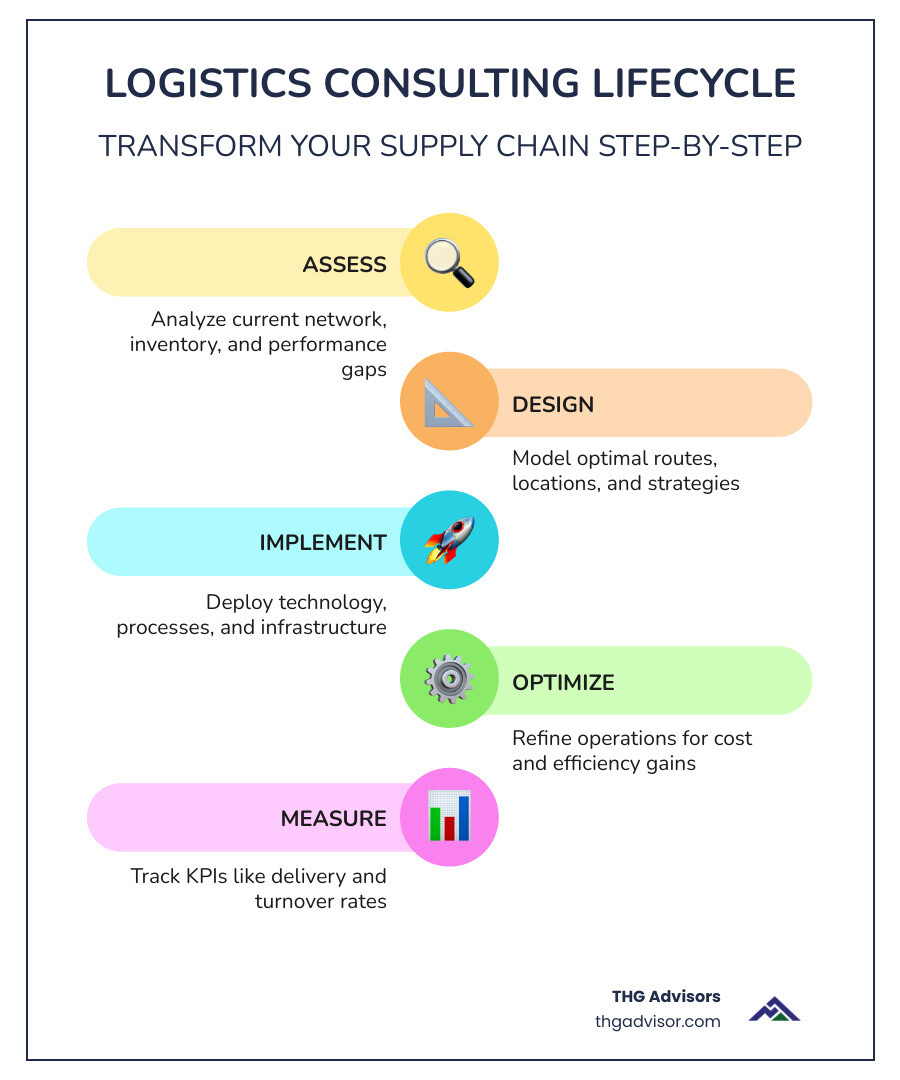
Defining Logistics Management Consulting for the Modern Enterprise
In the current business landscape, logistics management consulting is no longer a luxury reserved for global Fortune 500 giants. For any business generating between $10M and $250M in revenue, the supply chain is often where the battle for profitability is won or lost.
Modern logistics consulting is the practice of bringing in outside experts to analyze, "re-engineer," and optimize how goods move from point A to point B. It is an essential business tool because it addresses the "silent killers" of growth: bloated inventory, inefficient transportation routes, and outdated technology.
Why It Is Essential Today
We live in an era of constant disruption. Whether it is shifting consumer behaviors, fluctuating fuel prices, or geopolitical instability, the "old way" of managing logistics -- relying on manual spreadsheets and "gut feel" -- is a recipe for disaster.
By partnering with a logistics and supply chain management specialist, we can help you turn these risks into a competitive advantage. Effective consulting focuses on:
Risk Mitigation: Creating resilient systems that can withstand global disruptions.
Lead-Time Reduction: Shrinking the time between an order being placed and the product arriving at the door.
Inventory Performance: Ensuring you aren't tying up millions in "dead stock" while missing out on high-demand items.
Customer Service Levels: Meeting the modern expectation for fast, accurate, and transparent delivery.
For companies evaluating best practices and terminology, resources from organizations such as the Council of Supply Chain Management Professionals can also provide useful industry context alongside expert advisory support.
Core Services and Strategic Approaches to Optimization
When we engage in logistics management consulting, we don't just look at one piece of the puzzle. We look at the entire ecosystem. The goal is to fit all components—from the plant to the final mile—into a cohesive, high-performing engine.
Key services typically include:
Network Modeling: Determining the optimal number and location of warehouses to minimize shipping costs.
Inventory Deployment: Placing the right amount of stock in the right locations to meet demand without overstocking.
Transportation Assessment: Auditing freight spend, carrier contracts, and routing efficiency.
Warehouse Optimization: Improving the physical layout and workflow of distribution centers to boost productivity.
Inbound Logistics: Managing the flow of materials from suppliers to ensure production never hits a bottleneck.
Strategic Supply Chain Design
A strategic design is the "blueprint" for your future operations. It starts with end-to-end visibility—knowing exactly where every dollar and every pallet is at any given moment.
By leveraging resources like the Supply Chain Council, we help businesses align their logistics strategy with their overall business goals. This often leads to massive results. For example, some organizations have identified capex savings of around $500 million by developing long-term operations strategies that maintain high service standards while slashing unnecessary spending.
Strategic design isn't just about cutting costs; it’s about improving service levels. One engineering research firm we observed achieved a 100% on-time delivery rate and a 98% on-time pickup rate simply by refining their supply chain assessment and inventory visibility.
Digital Transformation in Logistics Management Consulting
Technology is the great differentiator in modern logistics. We are seeing a massive shift toward "smart" infrastructure. This involves more than just buying a new piece of software; it’s about a total digital transformation.
AI and Analytics: Using predictive modeling to anticipate demand spikes and adjust inventory before a crisis hits.
Automation and Robotics: Implementing automated sorting and packing solutions that can double order capacity without increasing headcount.
Blockchain Transparency: Creating unchangeable records of goods movement to build trust and eliminate documentation errors.
WMS & TMS Implementation: Selecting and deploying Warehouse Management Systems (WMS) and Transportation Management Systems (TMS) that actually talk to each other.

Measuring Success in Logistics Management Consulting
How do we know if the consulting is working? We use Key Performance Indicators (KPIs). These metrics allow us to track progress in real-time and make adjustments before small deviations become big problems.
Common KPIs include:
On-Time Delivery (OTD): The percentage of orders delivered by the promised date.
Inventory Turnover: How many times a company has sold and replaced its inventory during a specific period.
Freight Efficiency: The cost of transportation relative to the volume of goods moved.
Time-to-Value: How quickly the changes implemented by the consultant result in measurable financial gain.
Overcoming Supply Chain Challenges with Data-Driven Strategies
The logistics industry currently faces a "perfect storm" of challenges. Labor shortages make it harder to staff warehouses, while fuel volatility sends shipping costs into a tailspin. Furthermore, e-commerce has fundamentally changed customer expectations—people want things "now," and they want to be able to return them easily.
Logistics management consulting addresses these hurdles through data-driven strategies:
Sustainability and Decarbonization: With rising regulatory demands, consultants help businesses transition to zero-emission solutions and circular economy models.
Nearshoring: To avoid the risks of long-haul international shipping, many companies are moving operations closer to home (such as from overseas to Mexico) to serve the US market more efficiently.
Customs Compliance: Avoiding the 15-25% "hidden costs" of logistics spending caused by poor documentation and HS code errors.
Risk Resilience: Moving away from "just-in-time" inventory to "just-in-case" strategies that prioritize robustness over razor-thin margins.
Frequently Asked Questions about Logistics Consulting
How long does it take to see results from a logistics engagement?
The timeline varies based on complexity. We typically see "quick wins"—such as carrier contract renegotiations or simple process refinements—within 6 to 10 weeks. Major overhauls, like a full digital transformation or the construction of a new distribution network, can take 6 to 18 months to fully realize. However, a phased roadmap ensures you see incremental value throughout the journey.
How do businesses evaluate and select the right consulting partner?
Look for vendor neutrality. You want a partner who isn't trying to sell you a specific piece of software because they get a commission. Instead, prioritize:
Industry Expertise: Have they solved problems for businesses of your size and in your sector?
Objective Analysis: Do they use hard data to back up their recommendations?
Technical Proficiency: Do they understand the "stack" (AI, ERP, WMS) required to modernize your operations?
Strategic Fit: Do they take the time to understand your long-term business goals, or are they just offering a one-size-fits-all solution?
What role does sustainability play in modern logistics?
Sustainability is no longer just a "feel-good" initiative; it is a regulatory and financial necessity. Logistics management consulting now includes "green logistics" strategies, such as optimizing routes to reduce carbon footprints, sourcing sustainable packaging, and preparing for the transition to zero-emission trucking fleets.
Conclusion
Logistics problems have a way of quietly destroying businesses. What starts as a minor delay can snowball into lost sales and a tarnished reputation. But it doesn't have to be that way.
At THG Advisors, we believe that technology and strategy should be your greatest growth levers. Our Strategic CIO Catalyst Program provides the high-level leadership you need to turn your IT and logistics operations from a cost center into a revenue engine. We offer more than just advice; we provide a clear, board-ready roadmap and the embedded leadership to execute it.
Whether you are looking to reduce your warehouse costs by 20%, implement a cutting-edge AI strategy, or simply gain visibility into your global spend, we are here to help.
Ready to make your supply chain your unfair advantage? Explore our logistics and IT advisory services or book your Complimentary IT Maturity & Opportunity Audit (a $7,500 value) today. Let’s engineer your competitive edge together.