


The Consultant's Playbook: Mastering the Management Consulting Industry
Why Management Consulting Best Practices Separate High-Performing Firms from the Rest
Management consulting best practices are the proven methods that help consultants deliver real results — not just advice — across every stage of a client engagement.
Here are the core best practices at a glance:
Follow a structured delivery process — Assess, Plan, Implement, Optimize
Use data-driven insights — base every recommendation on evidence, not intuition
Collaborate closely with clients — align on goals, not just deliverables
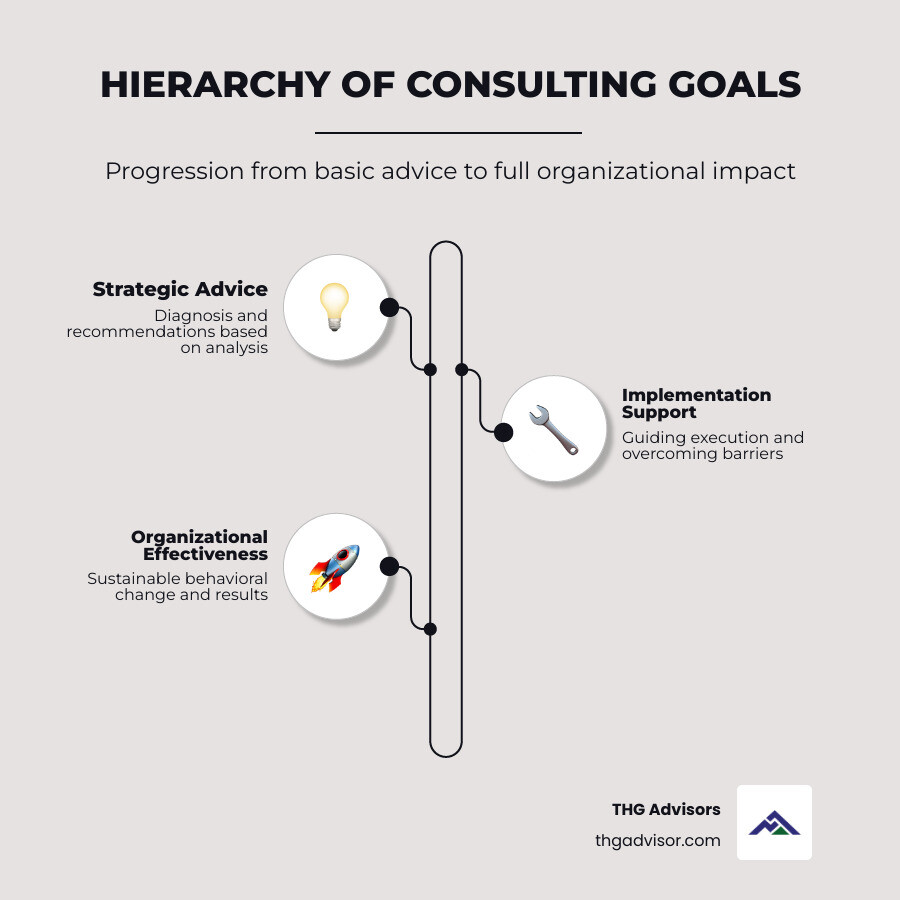
Move beyond advice to execution — support implementation and behavior change
Productize your services — standardize 80% of your offer for efficiency and scale
Price based on value — charge roughly 1/5th of the client's expected ROI
Use retainers — build recurring revenue and long-term client relationships
Track the right metrics — pipeline, utilization rates, and project profitability
Delegate low-value tasks — focus your time on high-impact work
Build thought leadership — consistent content builds authority and attracts ideal clients
Each year, management consultants in the United States receive more than $2 billion for their services. But here's the uncomfortable truth: a significant portion of that money gets spent on impractical data and recommendations that never get implemented. Clients expect more than a polished slide deck. They want measurable outcomes, hands-on support, and consultants who understand their business deeply enough to drive real change.
The gap between giving advice and delivering results is where most consulting engagements break down — and where the best practices in this guide make all the difference.
I'm Walt Carter, President and COO of THG Advisors, and with over 30 years of experience leading digital transformation and operational strategy across major organizations, I've built my career on applying management consulting best practices that close that gap between strategy and execution. In the sections ahead, I'll share the exact frameworks, pricing models, and scaling strategies that elite consulting firms use to win clients, deliver results, and build lasting businesses.
Core Management Consulting Best Practices for Project Delivery
To deliver a successful project, we must move beyond the "expert in the room" mentality. Elite firms succeed because they rely on a repeatable system rather than flashes of individual brilliance. According to 15 Consulting Best Practices: How Elite Consultants Run Their Firms, the foundation of a high-performing firm is a proven process that ensures consistency.
At THG Advisors, we emphasize Transformation Readiness and Operating Model Design to ensure a client is actually prepared for the change we are recommending. Without this readiness, even the best data-driven insights will fall on deaf ears.
Implementing Management Consulting Best Practices in Project Delivery
We recommend a 4-step consulting lifecycle: Assess, Plan, Implement, and Optimize.
Assess: Use hypothesis-driven frameworks to structure the problem. Instead of boiling the ocean, start with a "best guess" of the root cause and use data to prove or disprove it.
Plan: Develop customized solutions. While your process should be standardized, the solution must respect the client's unique culture and constraints.
Implement: This is where the rubber meets the road. Examples of Real Management Consulting Projects Explained show that projects with well-defined scopes are 30% more likely to deliver on time.
Optimize: Establish performance metrics. If you can't measure the ROI, the client won't perceive the value.

Transitioning from Advice to Execution
The "advice-only" model is dying. Modern clients demand implementation support. This requires a shift in how we view our role—moving from a temporary vendor to a partner in Coxswain Leadership, where we help steer the ship alongside the executive team.
To ensure expanded outcomes, we must adopt a "no-surprise" policy. This means frequent feedback loops and stakeholder engagement throughout the project, not just at the final presentation. When you involve the client in developing the recommendations, they are far more likely to own the behavioral change required for success.
Scaling Your Firm: Systems, Productization, and Resource Management
Scaling a consulting firm is notoriously difficult because the "product" is often the consultant's time. To break this linear trap, we must implement Adaptive Team-Centric Management. This involves balancing the needs of the client with the capacity of the team.
Scaling Through Management Consulting Best Practices and Systems
The secret to scaling is productization. Most consultants spend 80% of their time on custom work and 20% on repeatable tasks. Elite firms flip this ratio. By standardizing 80% of your offering, you can deliver higher quality at a lower internal cost.
We often leverage Interim and Fractional Executive Placements to provide clients with high-level expertise without the overhead of a full-time hire. This allows us to scale our impact by delegating specific execution tasks to specialized team members.
Key scaling strategies include:
Workload Balancing: Aim for a healthy utilization rate of 70% to 80%. Anything higher leads to burnout; anything lower leads to lost revenue.
Demand Forecasting: Use historical data to predict when you'll need more "hands on deck."
Workflow Automation: Document frequent tasks and automate them using modern CRM and project management tools.
Essential Resources for Professional Development
To stay at the top of your game, we recommend immersing yourself in the industry's foundational texts and resources:
The Trusted Advisor: Essential for understanding how to build client intimacy.
Flawless Consulting: The gold standard for communication and partnership skills.
Million Dollar Consulting: A masterclass in the mindset and marketing of a high-fee practice.
Professional Bodies: Engage with the Institute of Management Consultants (IMC USA) and study the ISO 20700 standard for professional services.
Mastering the Business of Management Consulting Best Practices
The most successful consultants don't sell hours; they sell outcomes. Understanding The Value of Hiring a Fractional CXO is a great way to see how high-level expertise can be decoupled from a 40-hour work week.
Value-Based Pricing and Revenue Goals
If you want to increase your fees, you must master the Value Conversation. This is a pre-proposal discussion where you uncover the economic impact of the project. A good rule of thumb is the 1/5th ROI rule: if your work will save or make the client $1 million, a $200,000 fee is an easy "yes."
We focus on Strategic Executive Alignment and Organizational Reframing to ensure that the value we provide is recognized at the highest levels of the organization.
To track your business health, look at your "Magic Number"—the number of sales conversations required to hit your monthly revenue goal. Elite consultants track pipeline metrics religiously to ensure they never face a "dry spell."
Leveraging Retainers for Stability
Revenue plateaus often happen because consultants are constantly hunting for the next big project. Retainers provide the solution. By offering ongoing access to your expertise, you create predictable cash flow and deeper client relationships. This shift from "transactional" to "relational" is a hallmark of management consulting best practices.
Building Authority and Attracting Ideal B2B Clients
In the B2B world, marketing is about building trust, not running flashy ads. You need a Magnetic Message. Use this formula: "I help [WHO] to [solve WHAT] so they can [RESULT]."
We use Leadership Capacity and Cultural Enablement as a cornerstone of our authority. When you can articulate your firm's values clearly, you attract clients who share those values, leading to smoother projects and higher satisfaction.
Strategic Planning and Agile Methodologies
In today's market, a five-year plan is often obsolete before the ink is dry. We recommend the SODA framework (Scan-Orient-Decide-Act):
Scan: Systematically look for risks and opportunities.
Orient: Develop a shared perspective on competitiveness.
Decide: Commit to a strategy across multiple time horizons.
Act: Translate strategy into priority actions with clear feedback loops.
Transitioning into the Industry
For young professionals looking to break into management consulting, the path involves more than just a degree. You must build a personal brand through thought leadership and networking.
Find a Mentor: Accelerate your learning by following those who have already paved the way.
Master Soft Skills: Data analysis is important, but the ability to influence a CEO is what gets results.
Daily Habits: Spend 30 minutes every day reading industry news or writing content to build your authority.
Frequently Asked Questions about Management Consulting Best Practices
What is the difference between consulting and project management?
While they often overlap, they serve different purposes. Consulting is primarily about diagnosis and recommendation—identifying what the problem is and how to fix it. Project management is about execution—making sure a predefined plan is delivered on time and within budget.
Feature Management Consulting Project Management Focus Solving complex business problems Executing specific deliverables Goal Strategic improvement / ROI On-time, on-budget delivery Outcome Recommendations and Change Completed Project Tasks
How do consultants calculate value-based fees?
We look at the total economic impact. If a project reduces turnover by 10%, what is that worth in hiring costs and lost productivity? Once that number is established, we aim to capture approximately 10% to 20% of that value as our fee.
Why is productization important for small firms?
Without productization, you are reinventing the wheel for every client. By creating "standardized offers," you reduce the time spent on administrative setup and proposal writing, allowing you to handle more clients without increasing your headcount.
Conclusion
Mastering management consulting best practices isn't about following a rigid set of rules; it's about adopting a mindset of excellence, accountability, and value creation. Whether you are a solo consultant or leading a large firm, the transition from "giving advice" to "driving results" is the only way to ensure long-term success in this $2 billion industry.
At THG Advisors, we live these practices every day through our Strategic CIO Catalyst Program. We provide the high-level technology leadership that turns IT departments into revenue engines, all while following the structured, value-based approach outlined in this playbook.
Ready to see how these best practices can transform your organization? More info about our services is available on our website, or you can reach out to us directly to start your journey toward business excellence.