


How to Start Implementing Process Improvements Without Breaking Everything
The Real Cost of Doing Nothing: Why Implementing Process Improvements Can't Wait
Implementing process improvements is the practice of identifying, analyzing, and optimizing how work gets done — making your workflows faster, more accurate, and more reliable over time.
If you want the short version, here's how to get started:
Identify the broken or slow process causing the most pain
Map the current steps so everyone can see what's actually happening
Analyze root causes — not just symptoms
Set SMART goals with clear ownership and deadlines
Pilot the improved process on a small scale first
Roll out changes with proper training and communication
Monitor results using KPIs and adjust as needed
Most organizations see early results within 30 to 90 days when they focus on a specific process.
Here's the uncomfortable truth: inefficiency isn't just annoying — it's expensive. Companies lose an estimated 20 to 30% of annual revenue to inefficient processes. Globally, poor workflows, operational risk, and bad user experiences drain up to $1 trillion every year.
Yet for most mid-sized businesses, process improvement stays at the bottom of the priority list — right until a competitor pulls ahead, a key customer leaves, or a team burns out trying to hold a broken system together.
The good news? You don't need to overhaul everything at once. Small, deliberate changes, applied consistently, compound into serious competitive advantage.
I'm Walt Carter, President and COO of THG Advisors, and over a 30-year career leading digital transformation for organizations like Fidelity, Gannett, and TRW, implementing process improvements has been at the heart of every successful operational turnaround I've led. In the sections ahead, I'll walk you through exactly how to do it without breaking what's already working.
Why Implementing Process Improvements is Critical for Modern Growth
In the business landscape of Georgia and beyond, staying stagnant is the same as moving backward. We often see organizations struggling not because they lack talent, but because their talent is trapped in "clunky" systems. Research shows that 20–30% of their annual revenue is lost to these very inefficiencies.
When we talk about implementing process improvements, we aren't just talking about tidying up a spreadsheet. We are talking about optimizing resource utilization and eliminating waste—whether that’s wasted time, redundant manual labor, or the "hidden factory" of fixing errors that should never have happened.
Effective process improvement drives:
Scalability: Processes that work for five people often break at fifty. Improvement ensures your infrastructure grows with your ambition.
Customer Satisfaction: Faster delivery and fewer errors lead to happier clients. For example, some businesses have reduced order fulfillment delays by 40% simply by streamlining their internal handoffs.
Employee Morale: No one likes doing "stupid" work. When we remove friction, we empower our teams to focus on high-value tasks, boosting engagement.
Market Adaptability: Organizations that embrace continuous improvement are nearly 1.5 times more successful in their projects because they can pivot when the market shifts.
Before diving into the "how," it is vital to assess your transformation readiness and operating model design. Without a foundation that supports change, even the best-laid plans can fail to take root.
7 Steps to Successfully Implementing Process Improvements
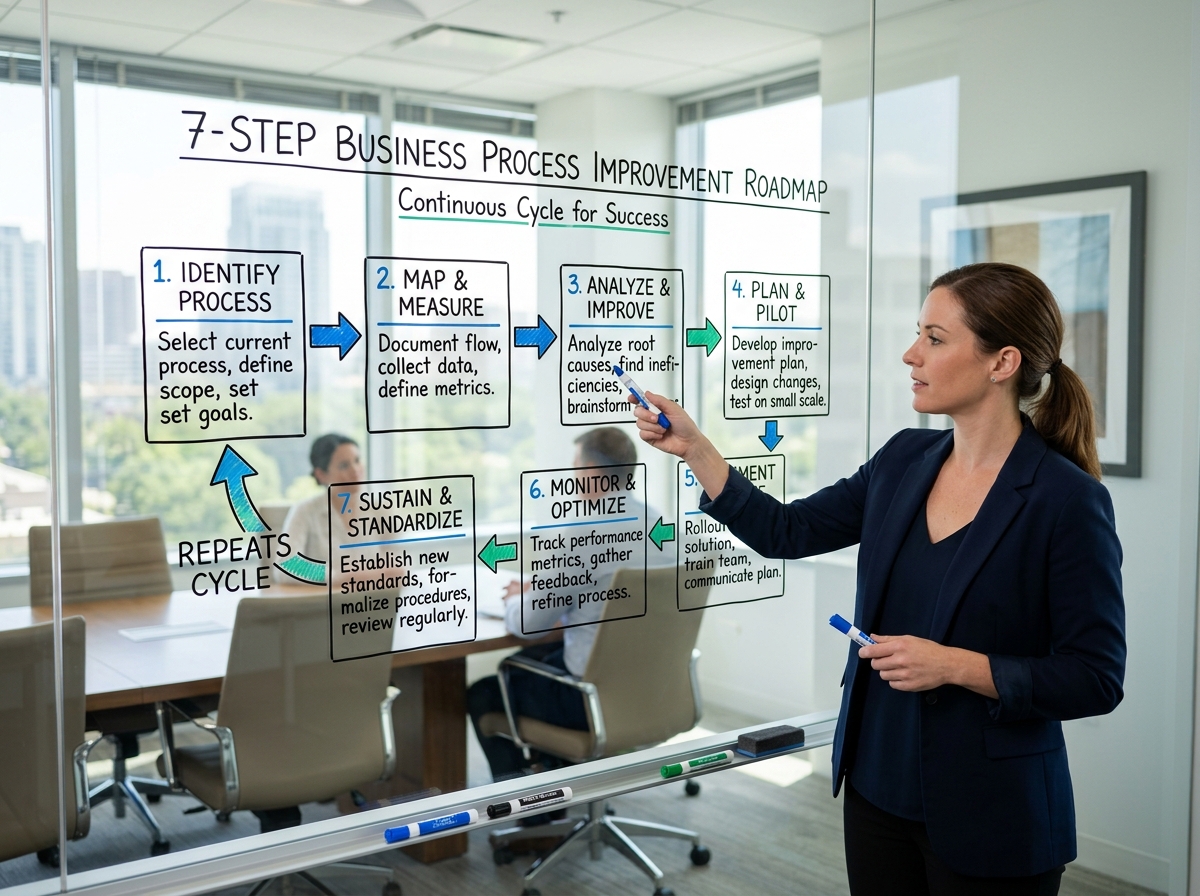
Successfully implementing process improvements requires a structured framework. We don't want to "break everything" by making wild guesses. Instead, we follow a disciplined path that balances speed with stability.
Feature Current State (The "As-Is") Future State (The "To-Be") Efficiency Manual, redundant, slow Automated, streamlined, fast Error Rate High due to human intervention Low due to standardized checks Visibility Siloed data and "black boxes" Real-time dashboards and transparency Ownership Unclear "who does what" Defined roles via RACI matrix
1. Identify the Opportunity
Start where the pain is greatest. Are customers complaining about a specific delay? Is there a task that takes three days when it should take one? Use data and feedback to pinpoint the bottleneck.
2. Map the Process
Visualize the workflow. Use sticky notes, flowcharts, or digital tools to document every single step. This often reveals "shadow processes" that management didn't even know existed.
3. Analyze Root Causes
Don't just patch the symptom. Use the ASQ guide on DMAIC (Define, Measure, Analyze, Improve, Control) to dig deep. Ask "Why?" five times until you find the source of the friction.
4. Redesign and Set Goals
Collaborate with the people who actually do the work. Brainstorm solutions and set SMART goals (Specific, Measurable, Achievable, Relevant, Time-bound).
5. Pilot the Change
Never roll out a massive change to the whole company on a Monday morning. Test your new process in a "sandbox" or with a single team to work out the kinks.
6. Implementation and Communication
Once the pilot succeeds, roll it out phased. Clear communication is non-negotiable—everyone needs to know what is changing, why, and how it helps them.
7. Monitor and Standardize
What gets measured gets managed. Track your results against your baseline. Once the improvement sticks, document it in Standard Operating Procedures (SOPs) to ensure the team doesn't revert to old habits.
Identifying Areas for Implementing Process Improvements
How do we know where to start? We look for the "warning signs": employee frustration, long wait times, or high defect rates. One of our favorite techniques is the Gemba Walk, a Japanese concept meaning "the real place." It involves leadership going to the "shop floor" (wherever the work happens) to observe workflows firsthand.
We also recommend using dashboards for process data to see bottlenecks in real-time. If you see a pile of "pending approvals" sitting in one person's queue for five days, you’ve found your first improvement project. Value stream mapping can further help by identifying which steps actually add value to the customer and which are just "noise."
Setting SMART Goals and Assigning Roles
A goal without a plan is just a wish. When implementing process improvements, we define success with precision. Instead of saying "we want to be faster," we say "we will reduce invoice processing time from five days to two days by Q3."
Role clarity is equally important. We use the RACI matrix to define who is:
Responsible: Doing the work.
Accountable: The "one head to pat or one throat to choke."
Consulted: Providing input.
Informed: Kept in the loop.
This aligns perfectly with adaptive team-centric management, where we empower teams to own their processes while maintaining clear accountability to the business strategy.
Proven Methodologies to Guide Your Strategy
You don't have to reinvent the wheel. Several world-class methodologies can provide the "railings" for your improvement journey:
Lean Manufacturing: Focused entirely on eliminating waste. If a step doesn't add value for the customer, Lean says get rid of it.
Six Sigma: A data-driven approach aimed at reducing defects and variability. It’s about consistency and "near-perfection."
Kaizen: A philosophy of continuous, small, daily changes. It’s the "1% better every day" rule.
PDCA (Plan-Do-Check-Act): Also known as the Deming Wheel, this is a four-step model for carrying out change.
Theory of Constraints: The idea that any complex system is only as strong as its weakest link (the bottleneck).
5S Method: A Japanese system (Sort, Set in order, Shine, Standardize, Sustain) designed to organize the workspace for maximum efficiency and safety.
A great real-world example is the Cleveland Clinic Lean Case Study, where they used Lean principles to redesign patient intake. By mapping the patient journey, they drastically reduced wait times and improved the quality of care without increasing costs.
For dynamic teams, Kanban boards and Agile methodologies are incredibly effective. Organizations using Kanban to track metrics like lead time have seen productivity increases of up to 45%.
Leveraging Technology for Implementing Process Improvements
In the modern era, technology is the "force multiplier" for process improvement. We can now automate work activities that previously absorbed 60-70% of an employee’s time, allowing teams to focus on higher-value strategic initiatives.
Key technological levers include:
No-Code Automation: Tools that allow business units to build their own workflows without waiting on IT.
AI and Machine Learning: Leveraging AI for master data management ensures your data is clean and actionable, which is the "fuel" for any process.
Collaborative Software: Centralizing documentation and communication eliminates versioning issues and ensures everyone is working from the "single source of truth."
Real-Time Reporting: Dashboards that show you exactly how a process is performing right now, not how it performed last month.
Overcoming Challenges and Sustaining a Culture of Excellence
The biggest hurdle to implementing process improvements isn't technology—it's people. Resistance to change is a natural human reaction. To overcome this, we practice coxswain leadership, where the leader acts as the "eyes and ears" of the boat, keeping everyone in sync and focused on the finish line.
To sustain a culture of excellence:
Strategic Alignment: Ensure your process goals match your overall business strategy. We offer strategic executive alignment and organizational reframing to help leaders get on the same page.
Psychological Safety: Employees must feel safe to point out flaws. If people are afraid of being blamed for "broken" processes, they will hide the problems instead of fixing them.
Training and Support: Don't just hand people a new tool; show them how to use it. 60% of employees believe better training would improve change management.
Reward Innovation: Celebrate the "small wins." When a team member finds a way to save an hour a week, recognize them publicly.
Frequently Asked Questions about Process Improvement
How do you measure the success of process improvements?
We look at several Key Performance Indicators (KPIs). Cycle time (how long a process takes from start to finish) and Error rates are the most common. We also look at ROI (cost savings vs. implementation cost) and Throughput (how much work is completed in a set period). We recommend using reporting features to track impact so you have objective data to show stakeholders.
What is the difference between incremental and breakthrough improvement?
Incremental improvement (Kaizen) involves small, ongoing tweaks that happen daily. They are low-risk and easy to implement. Breakthrough improvement (Business Process Reengineering) involves radical redesigns—starting from a blank sheet of paper to achieve dramatic results (like a 74% reduction in pre-development time). Breakthroughs are higher risk but offer much higher rewards.
How can I get my team on board with new processes?
Involve them early! The people doing the work usually have the best ideas for how to fix it. When you explain the "why"—for example, "we're fixing this so you don't have to work late on Fridays"—you build buy-in. Focus on leadership capacity and cultural enablement to ensure your managers are equipped to lead their teams through the transition.
Conclusion
Implementing process improvements is not a one-time project; it is a mindset. At THG Advisors, we bring decades of experience and award-winning expertise to help you navigate these changes without "breaking" your core business. Whether you are in Atlanta or anywhere across Georgia, we are here to help you drive success through innovative business solutions.
Ready to stop the chaos and start building leverage? Start your transformation journey with us today.