


The Magical Trifecta of Process Improvement and Change Management
Why Continuous Improvement and Change Management Are Both Essential to Organizational Success
Continuous improvement and change management are two of the most powerful tools available to business leaders — and knowing how to use both is the difference between organizations that thrive and those that fall behind.
Here is a quick breakdown of how they differ and work together:
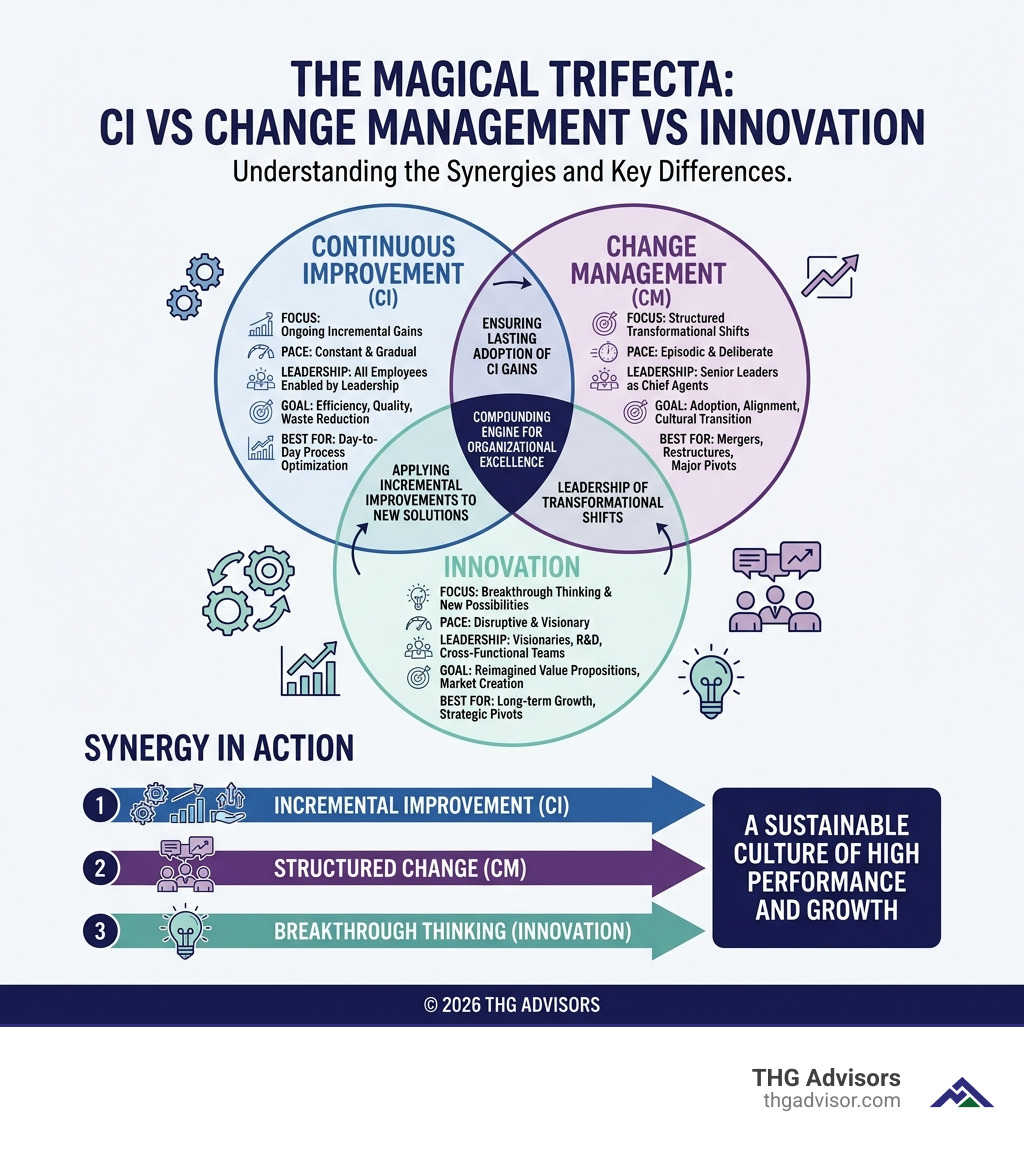
Continuous Improvement (CI) Change Management (CM) Focus Ongoing, incremental process gains Structured, transformational shifts Pace Constant and gradual Episodic and deliberate Who leads it All employees, enabled by leadership Senior leaders as chief agents Goal Efficiency, quality, waste reduction Adoption, alignment, cultural transition Best used for Day-to-day process optimization Mergers, restructures, major pivots Work together? Yes — CI initiatives often require CM to ensure lasting adoption
Most organizations default to one or the other. That is a mistake.
CI without change management leads to improvements that do not stick. Change management without CI creates one-time fixes that fade. Together, they form a compounding engine for organizational excellence.
There is also a third element that amplifies both: innovation — the breakthrough thinking that opens entirely new possibilities. These three concepts form what we call the magical trifecta of organizational performance.
As Kaizen pioneer Masaaki Imai put it: "Not a day should go by without some kind of improvement being made somewhere in the company." That mindset, paired with structured change leadership and bold innovation, is what separates good organizations from great ones.
I'm Walt Carter, President and COO of THG Advisors, and I have spent over 30 years leading large-scale digital transformations and helping organizations build lasting cultures of continuous improvement and change management across industries including financial services, media, and technology. In the sections ahead, I will walk you through the frameworks, leadership strategies, and real-world tools that make this trifecta work in practice.
Defining the Roles of continuous improvement and change management
To master the art of organizational evolution, we must first understand that while these terms are often used interchangeably, they serve distinct purposes. Think of continuous improvement and change management as the "engine" and the "steering wheel" of your company. One keeps you moving forward efficiently, while the other ensures you don't crash when taking a sharp turn.
Incremental vs. Episodic
Continuous improvement is a philosophy of "betterment every day." It is an ongoing, linear process focused on small, incremental gains. It’s the constant tweaking of a workflow to shave off five minutes of waste or the daily habit of frontline workers suggesting a better way to organize a digital file.
In contrast, change management is often episodic and disruptive. It is a structured approach used to transition individuals and teams from a current state to a specific future state—usually following a major event like a merger, a new software rollout, or a complete shift in business strategy. While CI is a marathon with no finish line, CM is a series of sprints designed to clear high hurdles.
Purpose Alignment
The Continuous Improvement Model - ASQ emphasizes that CI is about perfecting existing processes. However, even the most logical process improvement will fail if the people involved refuse to use it. This is where the human side of change comes in.
Effective change management addresses the psychological transition of the workforce. It ensures buy-in, manages resistance, and provides the training necessary for a "new way of doing things" to actually stick. When we look at automation-process-improvement, we see that the most successful tech rollouts are those where the technical "fix" (CI) is paired with a robust strategy to help the team adapt (CM).
Feature Continuous Improvement Change Management Primary Driver Data and process efficiency People and organizational readiness Frequency Daily / Constant Project-based / Periodic Scope Localized or systemic tweaks Transformational shifts Risk Level Low (incremental) High (disruptive)
Proven Methodologies for Driving Sustainable Progress
At THG Advisors, we believe that "gut feeling" is no substitute for a disciplined methodology. To bridge the gap between continuous improvement and change management, several time-tested frameworks provide the necessary structure.
The PDCA Cycle: Your Scientific Foundation
The PDCA Cycle for Change (Plan-Do-Check-Act) is the bedrock of process improvement.
Plan: Identify an opportunity and plan a change.
Do: Test the change on a small scale.
Check: Review the test, analyze the results, and identify what you learned.
Act: If the test was successful, implement it on a wider scale. If not, begin the cycle again.
This iterative approach reduces risk by allowing for small-scale failures before committing significant resources.
Kaizen and Lean Six Sigma
Kaizen, the Japanese philosophy of "change for the better," encourages every employee to identify waste (Muda) and suggest improvements daily. It is less about "big bang" events and more about the compounding interest of tiny wins.
On the more technical side, Lean Six Sigma utilizes the DMAIC (Define, Measure, Analyze, Improve, Control) framework. This is particularly effective in high-stakes environments like healthcare or manufacturing, where data-driven precision is required to eliminate defects and reduce variation. By focusing on adaptive-team-centric-management, organizations can ensure these methodologies don't become cold, mechanical exercises, but rather tools that empower the people closest to the work.
Leadership Strategies for Organizational Success
You can have the best Lean Six Sigma black belts in the world, but if your leadership team isn't aligned, your initiatives will stall. Leadership is the "secret sauce" that makes continuous improvement and change management work in harmony.
Senior Sponsorship and Cultural Embedding
Leadership's primary role is to create a "safe to fail" environment. If employees fear that a failed CI experiment will result in a poor performance review, they will stop innovating. Leaders must actively model a growth mindset, showing that they value learning just as much as they value efficiency.
We must also work on breaking-through-the-glass-ceiling by ensuring that improvement opportunities are accessible to everyone in the organization, regardless of their level. When the frontline feels heard, engagement skyrockets. Research shows that highly engaged employees can lead to up to 23% higher profitability.
Leadership Roles in continuous improvement and change management
The roles differ slightly depending on the goal:
Enablers for CI: In continuous improvement, senior leaders act as enablers. They provide the platforms, the tools, and the time for local teams to collaborate and experiment.
Chief Agents for CM: In transformational change management, leaders must be the chief agents of the vision. They are responsible for the "Why" and must communicate it relentlessly to prevent the rumor mill from sabotaging progress.
Sometimes, bringing in outside expertise can provide the necessary spark. We often discuss the-value-of-hiring-a-fractional-cxo to bridge leadership gaps during major transitions. Much like coxswain-leadership in rowing, a leader's job is to keep everyone in sync, pulling in the same direction at the right tempo.
Overcoming Challenges in continuous improvement and change management
Resistance is a natural human reaction to change. People aren't necessarily resisting the improvement; they are resisting the uncertainty. Common hurdles include:
Resource Constraints: Teams are often too "busy" fighting fires to install a sprinkler system.
Short-Term Focus: Quarterly profit pressures can kill long-term CI initiatives.
The "We've Always Done It This Way" Mentality: This is the most dangerous phrase in business.
According to the experts at Prosci, Continuous Improvement Requires Strong Change Management because even small process tweaks require people to change their habits. Without a structured way to address the "people side," resistance will eventually overwhelm the process.
Measuring Success and Ensuring Long-Term Sustainability
How do you know if your efforts are actually working? You can't manage what you don't measure.
Key Performance Indicators (KPIs) and ROI
The results of integrating continuous improvement and change management can be staggering when measured correctly:
Intel achieved an 80% reduction in expenses by using Lean waste elimination strategies.
The University of Virginia (UVA) completed 275 improvements using structured change management, resulting in $21.9 million in annual savings and a cumulative $82.1 million over four years.
Serigraph used Six Sigma to improve yield by 20%, saving $40,000 in just ten months.
Beyond the balance sheet, we also measure "soft" metrics like employee satisfaction and quality. Statistics show that 36% of all improvements directly impact quality, and 31% increase staff and customer satisfaction.
Sustaining the Gains
Sustainability is where most organizations fail. They treat change like a project with an end date rather than a new way of living. To ensure improvements last, they must be "institutionalized"—meaning they are written into SOPs, included in performance reviews, and celebrated in company-wide meetings.
As we navigate the-evolution-and-future-of-hybrid-work-recommendations-and-measuring-impact, measuring impact becomes even more critical. In a remote or hybrid environment, visual dashboards and daily digital huddles replace the physical "war room," but the principles of accountability remain the same.
Frequently Asked Questions about Organizational Transformation
Why are continuous improvement and change management often confused?
They are confused because they both involve "change." However, CI is about the process (doing the work better), while CM is about the people (helping the workers adapt to the new process). CI is the "what" and "how," while CM is the "who" and "why."
When is it most appropriate to use formal change management?
Formal change management is essential for "high-stakes" transitions. If the change involves a significant shift in job roles, a major technology implementation (like an ERP system), or a cultural overhaul after an acquisition, you need a structured CM framework like ADKAR (Awareness, Desire, Knowledge, Ability, Reinforcement).
How do Lean and Six Sigma integrate with people-focused change?
Lean and Six Sigma provide the data and the "logical" reason for change. However, data rarely moves people’s hearts. By integrating these with change management, you use the data to prove why the change is needed, but you use CM tools (like communication plans and coaching) to help the team actually cross the finish line.
Conclusion
At THG Advisors, we have seen that the organizations that win are those that master the "Magical Trifecta." By aligning continuous improvement and change management with a bold spirit of innovation, you create an organization that doesn't just react to the market—it shapes it.
Whether you are looking to shave costs through Lean Six Sigma or lead your team through a massive digital transformation, we are here to provide the award-winning expertise and dedicated support your business deserves. Don't leave your organizational excellence to chance.
Transform your business with THG Advisors and let us help you build a culture that gets better every single day.