

The Quick Guide to Continuous Improvement in Project Management
Why Continuous Improvement Project Management Is the Key to Staying Competitive
Continuous improvement project management is a structured approach where teams make small, ongoing changes to processes, products, and workflows — rather than waiting for big overhauls — to steadily reduce waste, raise quality, and deliver more value.
Here is a quick snapshot of how it works in practice:
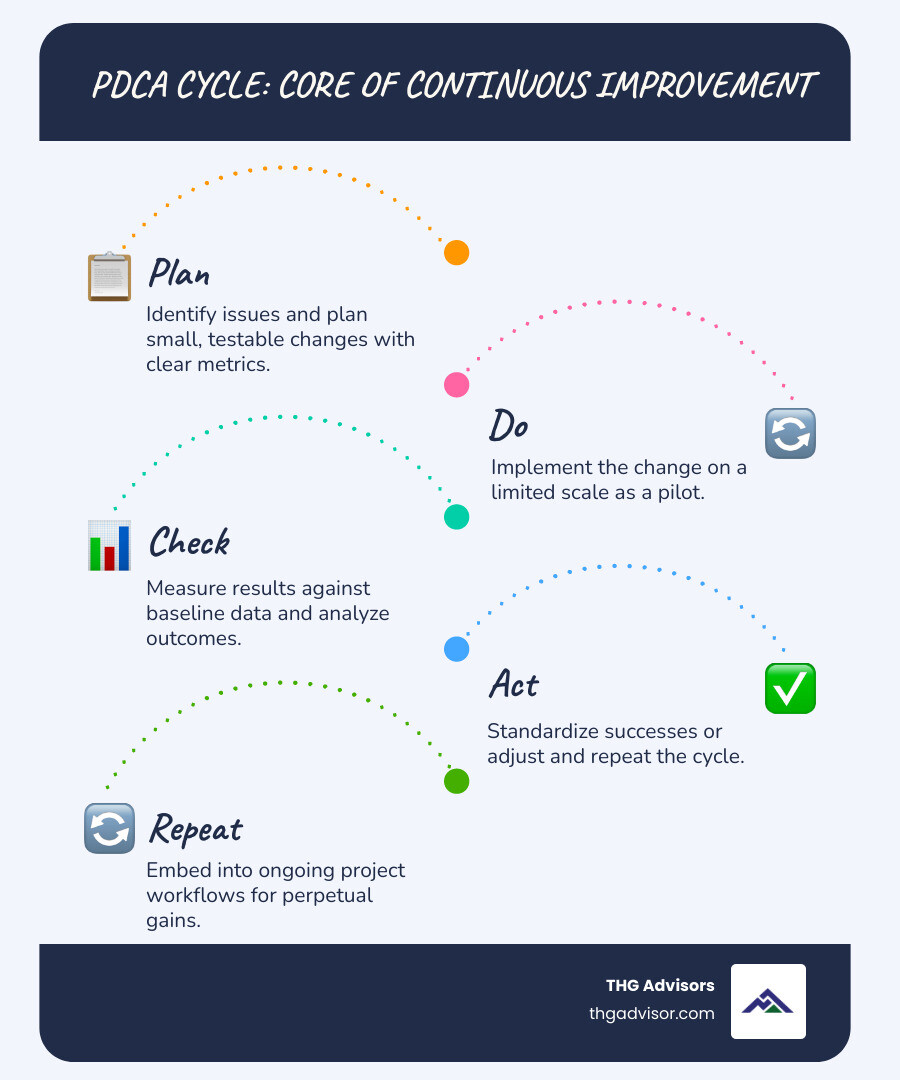
Identify a problem or inefficiency in your current workflow
Plan a small, testable change with clear success metrics
Implement the change on a limited scale
Measure the results against your baseline
Standardize what works — or adjust and repeat what doesn't
This cycle — often called Plan-Do-Check-Act (PDCA) — is the engine behind methodologies like Lean, Six Sigma, and Kaizen, and it applies directly to how project teams operate day to day.
For mid-sized businesses, the stakes are real. The Project Management Institute projects nearly 22 million new project management jobs globally by 2027, signaling that how organizations manage and improve their projects is becoming a core competitive skill — not just a back-office function.
Yet many business owners still treat improvement as a one-time event: a big reorganization, a new software rollout, a strategy retreat. The research is clear that incremental, ongoing change consistently outperforms shifts — it allows more reflection, broader team involvement, and better control over outcomes.
I'm Walt Carter, President & COO of THG Advisors, and over 30 years of leading digital transformation and operational initiatives across industries, I have seen how embedding continuous improvement project management into an organization's DNA separates businesses that scale from those that stall. In this guide, I'll walk you through exactly how to do that.
What is Continuous Improvement Project Management?
In modern business, standing still is the fastest way to fall behind. We often view continuous improvement project management as a state of "perpetual beta." This means we are never truly "done" with a process; instead, we are always looking for the next incremental gain. It is a mindset that replaces the "we've always done it this way" excuse with a "rethinking cycle" that prizes data and fresh perspectives over ego.
Traditional project management often follows a linear path: you plan, you execute, and you close. While this works for simple tasks, it often fails in complex environments where requirements shift. Continuous approaches, however, integrate Adaptive Team Centric Management to ensure that the team is constantly reflecting on their performance and the value they provide to the customer.
The goal is simple: maximize customer value while minimizing waste. By adopting Continuous Improvement Practices, organizations gain a significant competitive advantage. They become more flexible, allowing them to pivot when market conditions change without the chaotic friction that usually accompanies a corporate "course correction."
Core Methodologies for Continuous Improvement Project Management
To make improvement more than just a buzzword, we use structured methodologies. These frameworks provide the "rules of the road" for how we identify and fix problems.
PDCA/PDSA Cycle: The "Plan-Do-Check-Act" (or Study) cycle is the heartbeat of Lean. You identify a problem, test a solution on a small scale, study the results, and then adjust your standard work.
Six Sigma (DMAIC): This is the "heavy lifter" for reducing variation. DMAIC stands for Define, Measure, Analyze, Improve, and Control. It is incredibly rigorous—Six Sigma processes are considered optimized only if they produce fewer than 3.4 defects per one million cycles.
Kaizen: A Japanese philosophy meaning "change for the better." It emphasizes that everyone, from the CEO to the frontline staff, should contribute small, daily improvements.
Lean Principles: Lean focuses on the "Five S" and the elimination of "Muda" (waste). In project management, this means removing unnecessary meetings, redundant documentation, and idle waiting time.
When these are combined with modern Kaizen and project management software, the result is a transparent, high-velocity environment where bottlenecks are visible and addressed in real-time.
Key Steps to Implement Continuous Improvement Project Management
Implementation doesn't happen by accident. It requires a deliberate, step-by-step approach to ensure the changes stick.
Identify Opportunities: We look for "pain points"—where are projects stalling? Where is the budget leaking? We use feedback from customers and employees to build an "idea funnel."
Root Cause Analysis: Before fixing a symptom, you must find the disease. We use techniques like the "5 Whys" (asking why five times to get to the core issue) or Fishbone diagrams.
Pilot Testing: Never roll out a massive change across the whole company at once. Run a "controlled experiment" with one team or one project.
Feedback Loops: Use Automation Process Improvement to collect data automatically. If a new workflow step takes longer than the old one, the data will tell you immediately.
Standardizing Work: Once a pilot is successful, it becomes the new Standard Operating Procedure (SOP). This ensures consistency and prevents the team from sliding back into old habits.
Essential Tools and Leadership Behaviors for Success
You can have the best methodology in the world, but if your leadership culture is toxic or your tools are outdated, the initiative will fail. Success in continuous improvement project management relies on a foundation of humility. Leaders must be willing to admit they don't have all the answers and embrace ideas from the frontline workers who are closest to the process.

We focus on "process over blame." When a mistake happens, a CI-focused leader doesn't ask "Who messed up?" but rather "What part of our process allowed this error to occur?" This creates psychological safety, which is essential for honest retrospectives. Furthermore, establishing a "clarity of purpose" ensures that every small improvement aligns with the company’s high-level strategic goals.
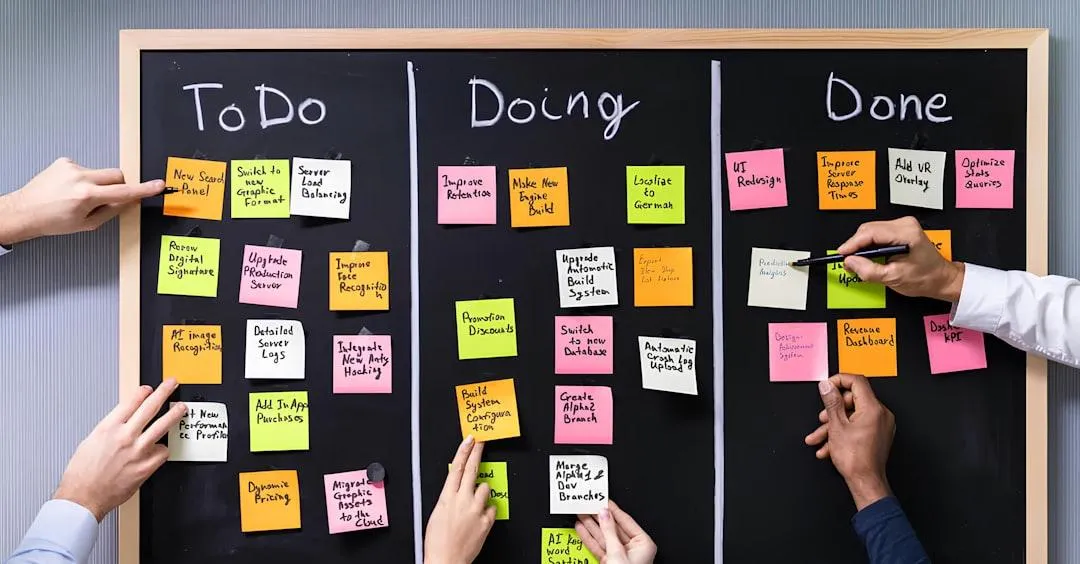
When we are Optimizing In House Software Development, we prioritize visual task management. If you can't see the work, you can't improve it. Tools like Gantt charts provide the timeline, but Kanban boards provide the flow.
Digital Support for Ongoing Refinement
Digital tools act as the central nervous system for continuous improvement. They provide the "active alerts" and notifications that keep a project from drifting off course.
Key digital features include:
Kanban Views: These allow for "Visual Task Load Management," ensuring no single team member is overwhelmed while others are idle.
Data Democratization: Everyone on the team should have access to the same KPIs. When data is transparent, teams can self-correct without waiting for a manager's intervention.
Real-Time Reporting: Instead of waiting for a monthly status report, digital dashboards provide a "perpetual" view of project health.
As noted in the research on Driving Progress: Continuous Improvement Project Management Essentials, digital support is one of the three critical pillars of CI success, alongside methodology and leadership behavior.
Overcoming Challenges and Measuring Impact
The biggest hurdle to improvement isn't technical—it's psychological. The "overconfidence bias" often leads project managers to believe their initial estimates are perfect. They rely on "single-point estimates" (e.g., "This will take 5 days") which are almost always wrong.
To counter this, we use stochastic analysis and Monte Carlo simulations. These tools allow us to express estimates as a range of probabilities. For example, instead of saying a project will finish on Friday, we can say there is a "90% confidence interval" that it will finish between Wednesday and next Tuesday. This level of realism is a hallmark of The Value Of Hiring A Fractional Cxo, who brings the seasoned perspective needed to challenge internal biases.
Metrics for Operational Excellence
If you aren't measuring it, you aren't managing it. To achieve operational excellence, we track several key metrics:
Cycle Time: The total time it takes to complete one task from start to finish.
Throughput: The number of tasks or "units of value" delivered in a specific timeframe (e.g., per week).
Lead Time: The time from when a request is made to when it is delivered to the customer.
Defect Density: The number of errors or "rework" items found in a project deliverable.
Financial Impact: Tracking both projected and actual savings ensures the CI program is paying for itself.
Frequently Asked Questions about Continuous Improvement
How does continuous improvement differ from Kaizen?
While the terms are often used synonymously, there is a subtle difference. Continuous improvement is the overarching business strategy and umbrella term. Kaizen is a specific Japanese philosophy that focuses on "bottom-up" change. In a Kaizen culture, the emphasis is on small, daily changes led by the workers themselves, rather than large projects led by external consultants.
What are the main benefits of integrating this into project management?
The primary benefits include massive efficiency gains and waste reduction. By empowering employees to fix the problems they see every day, you increase engagement and morale. From a business perspective, it leads to significant cost savings, higher quality outputs, and reduced process variation—which means your customers get a consistent, high-quality experience every time.
How do you overcome resistance to change in a project team?
Resistance usually stems from fear of the unknown or "change fatigue." We overcome this through visible leadership commitment and by starting with small, incremental shifts that don't disrupt the team's entire world. Recognizing and rewarding contributions is also vital. When a team member suggests an improvement that saves the company time, that success should be celebrated publicly.
Conclusion
At the end of the day, continuous improvement project management isn't about achieving perfection; it’s about the relentless pursuit of "better." It requires a blend of the right methodologies, supportive leadership, and the digital tools to make work visible.
For many mid-sized organizations, the leap from "keeping the lights on" to "operational excellence" feels daunting. That is where we come in. At THG Advisors, we specialize in helping businesses bridge that gap. Whether you need a strategic roadmap or a hands-on leader to Transform your operating model, our decades of experience ensure your technology and processes become your greatest growth levers.
If you are ready to turn your IT and project workflows into a high-efficiency engine, let's talk. We can help you navigate the complexities of digital transformation and ensure your team is equipped for the 22 million new project roles the future holds.